


This is the Ride AI newsletter: The most comprehensive weekly digest of news and intelligence at the intersection of technology and transportation.
Deep Diving the Chinese AV Industry

I recently had the immense pleasure of continuing my Ride AI panel and doing something I’ve always wanted to do: a deep dive with Dr. Leo Wang, CFO of Pony.ai, one of China’s foremost robotaxi companies, about the state of Chinese AVs, Chinese government regulation, and how a Chinese company such as Pony thinks about bringing their services to a global market. Turns out, it’s not really as straightforward as you might think. Give the episode a listen and let me know what you think. (heads up: it’s a long one. I wasn’t kidding about the deep dive)
Top Story
Wayve will put the Wayve AI Driver into future Mercedes vehicles within the next two years, according to a production agreement the company signed with Mercedes-Benz. The system will offer urban and highway point-to-point driving assistance, and it’s Wayve’s first deal in the premium segment.
It’s also Wayve’s third production agreement in less than nine months, following Nissan and Stellantis. Mercedes invested in Wayve’s $1.5 billion Series D in February, and the two companies have spent several years integrating the AI Driver into Mercedes’ own production hardware, MB.OS operating system, and map interfaces. Wayve has posted footage of those test cars driving on city streets, freeways, and country roads in Stuttgart, London, and San Francisco.
The deal means Mercedes now has three separate driving systems in the works. There’s Drive Pilot, its in-house Level 3 highway system, and the Nvidia-based L2+ system built on Alpamayo that debuted in the CLA earlier this year, which also offers point-to-point assistance. I asked Mercedes whether Wayve’s system would run alongside the Nvidia one, and the company confirmed that the Wayve partnership is independent of its other collaborations, with MB.OS serving as the common platform that ties its different partners together.
This all sounds like Mercedes is hedging its bets. Having multiple suppliers for overlapping L2 products keeps Mercedes from being locked into a single end-to-end approach while it figures out which one scales better. For Wayve, landing a premium brand is a big validation of its licensing model, especially since the same Driver is also powering its robotaxi pilots with Uber. It also means that companies previously thought to have a moat, like Mobileye, are actually more vulnerable than expected.
Domestic News
Aurora is targeting more than 30,000 driverless trucks on the road by 2030, a goal it laid out at its Analyst & Investor Day this week alongside a multi-billion dollar revenue target for that year. The company says it’s on track to have 200 driverless trucks running by the end of 2026, and it has nearly doubled its number of driverless customers this year.
The biggest new commitment comes from Hirschbach, which intends to own and operate 500 trucks under a Driver as a Service agreement, with deliveries starting in 2027. Aurora says it’s negotiating more of these deals. On the economics side, driverless trucks running for McLane, Werner, and others average an annualized 225,000+ miles, more than double a conventional truck, and Aurora’s second-generation hardware kit cuts hardware costs by more than half. The company says that combination points to positive gross profit, though it didn’t put a date on it.
Kodiak, meanwhile, has named Dallas to Houston as the launch lane for its driverless long-haul service. The route is a 219-mile stretch of I-45 the company plans to run with nobody in the cab by the end of this year. Kodiak’s safety case readiness measure hit 93% in August, and it has been completing intervention-free deliveries from Lancaster, Texas to Houston since then.
Waymo has published new safety data covering 271 million driverless miles, through the end of June, showing 82% fewer injury-causing crashes than human drivers across Atlanta, Austin, Phoenix, LA, and the San Francisco Bay Area. That’s 50 million more miles than the previous update through March. For crashes causing serious injury or worse, the reduction was 95%.
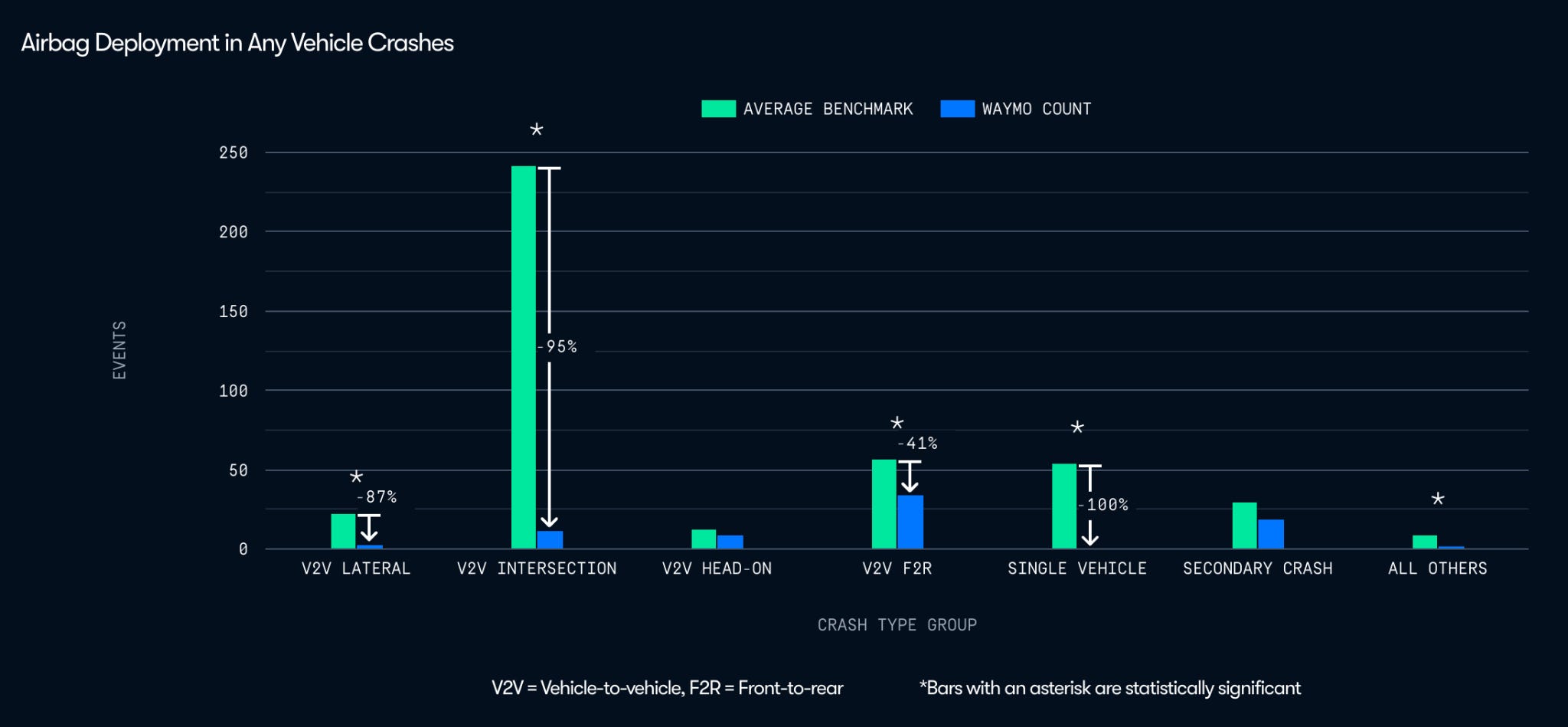
It continues to be difficult to argue with the safety data presented. Vehicle-to-vehicle crashes at intersections, in other words, crashes caused by drivers running red lights, saw a 95% reduction. The data also highlights 93% fewer pedestrian injury crashes, 86% fewer cyclist injury crashes, and 82% fewer motorcyclist injury crashes. By Waymo’s math, that adds up to 841 fewer injury-causing crashes than human drivers would have been expected to have over the same miles, more than 175 of which would have injured pedestrians, cyclists, or motorcyclists, and about 55 of which would have caused serious injuries or worse.
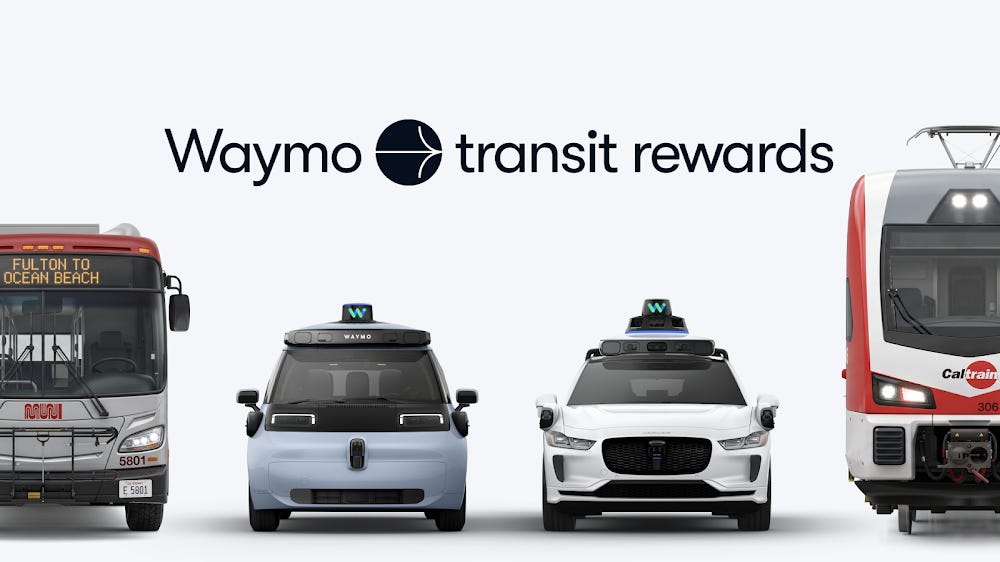
Waymo has launched a transit rewards program with Visa in the Bay Area, issuing $2.85 in Waymo Cash, the price of a San Francisco bus fare, whenever a rider pays for a Waymo trip and a transit trip with the same Visa card within two hours of each other. The program mirrors the Bay Area’s regional transfer discount and works across the 27 local agencies that accept contactless Visa. It’s opening to employees first before rolling out to the public over the coming weeks.
Waymo is also launching mobility hub partnerships with transit agencies, starting with Caltrain, where it’s leasing 40 dedicated parking spaces at stations so cars can wait closer to riders coming off the train, along with reduced ETAs and rider rewards. Waymo says more than half of its riders in San Francisco, LA, and Phoenix also ride public transit. The Bay Area program builds on earlier transit credit pilots in LA and Chandler, Arizona.
Elsewhere, Waymo has started offering driverless freeway rides in Austin on MoPac, I-35, US 183, and US 290, its first freeway service in Texas. It has also opened teen accounts in Nashville for riders aged 13 to 17, its second teen market after Phoenix. And the fleet behind all this is growing quickly. Waymo now runs roughly 4,000 robotaxis and averages 500,000 paid rides a week, and its Texas fleet has grown 49% in just the past three weeks to 1,102 vehicles. Most of these new vehicles are the Ojai, built on Chinese vehicle manufacturer Zeekr’s platform.
NHTSA has opened an investigation into comma.ai’s openpilot, the aftermarket hands-off driver-assist system often advertised as “an android phone on your windshield”, after five crashes, two of them fatal, in which the system allegedly failed to detect or respond to slow or stopped vehicles in its lane. Three people died and up to 11 were injured across the crashes.
One of the fatal crashes happened in Louisiana in February, when a 2022 Toyota RAV4 hit a stopped police car with its emergency lights on, killing two rear-seat passengers. That car was running FrogPilot, a community fork of openpilot. Because openpilot is open source, NHTSA will have to sort out how much responsibility comma bears for modified versions of its software it doesn’t control, which makes this a much messier case than a typical probe.
Tesla has started delivering its production Semi, nearly nine years after first unveiling the original, at a new Semi-only factory in Reno, Nevada that Tesla says can build up to 50,000 trucks a year. The long-range version is rated for 500+ miles fully loaded and costs just under $300,000 before incentives, and Tesla’s Megachargers can take it from 0 to 60% in 30 minutes.
The glaring omission, though, is any sort of driver assistance, a la FSD, something Tesla says will be added in the near future. If and when it does get added, it could give trucking companies like the above-mentioned Aurora and Kodiak some pause.
International News
The EU has delayed its vote on Tesla’s FSD Supervised, pushing it to December at the earliest after the agenda for the October 6 meeting of its Technical Committee on Motor Vehicles listed only a 25-minute continuation of discussions on the Netherlands’ request, with no vote. Seven countries have recognized the Dutch approval so far, about 12% of the EU’s population, while a qualified majority needs 15 states representing 65%. Germany, Italy, Spain, and France, which together hold 58% of the population, haven’t yet signed on.
So what’s the main sticking point? Speeding, seemingly. Germany’s KBA has contacted the Dutch regulator RDW and Tesla to lay out Germany’s position on FSD choosing to exceed posted speed limits on its own. Sweden has also demanded that Tesla remove its Speed Offset function, with backing from Norway and Finland. A Brussels pedestrian and cyclist safety group found FSD sped in 55% of the 30 km/h segments it tested, averaging 44 km/h, largely because the car’s display read those zones as 50 km/h. It also repeatedly tried to overtake cyclists on streets where the maneuver was prohibited.
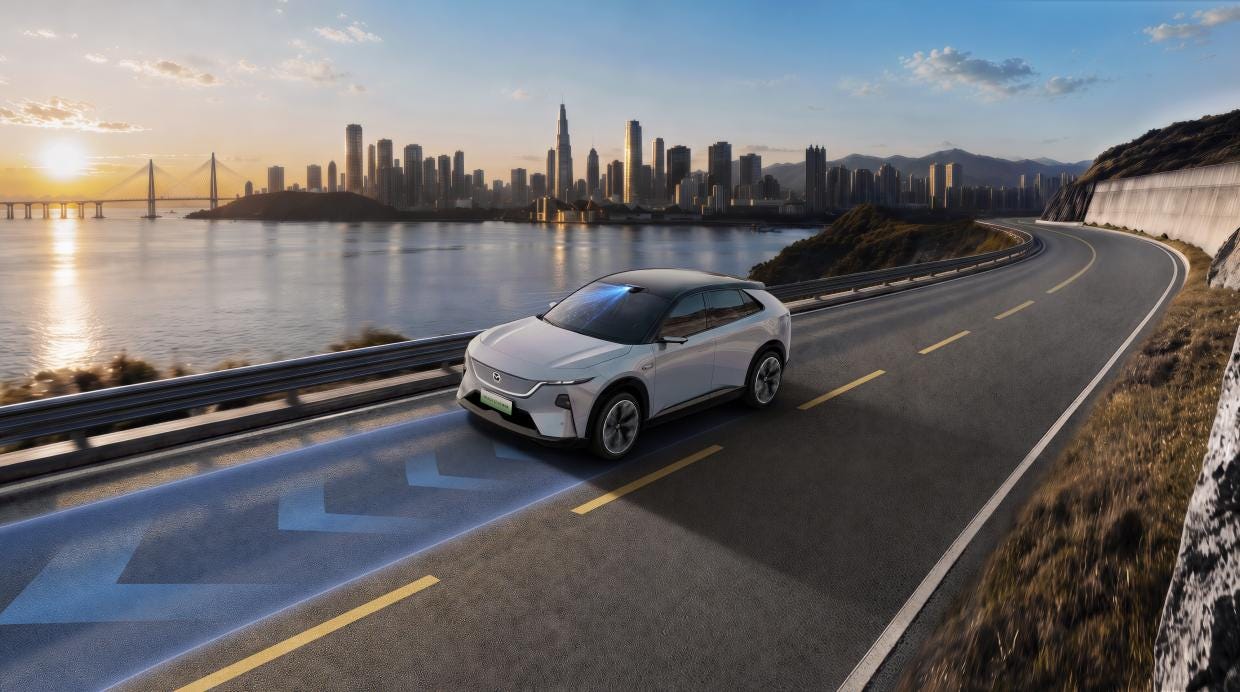
Mazda has added lidar to its EZ-60 in China, enabling highway and city navigation on autopilot along with automated parking on the Changan-built SUV, which is sold abroad as the CX-6e. The new lidar-enabled vehicle is branded “EZ-6 0 Lazer Edition”, which is definitely not tacky at all. Tencent supplies the lane-level navigation and the architecture behind the system, which runs on a lidar, 11 cameras, 3 radars, and 12 ultrasonic sensors. I touch on this in the podcast episode with Leo (linked above), but lidar-equipped NOA is quickly becoming table stakes in China, and foreign brands that hadn’t invested in this type of system before (like Mazda) are finding that they need to lean on domestic technology partners to keep up.
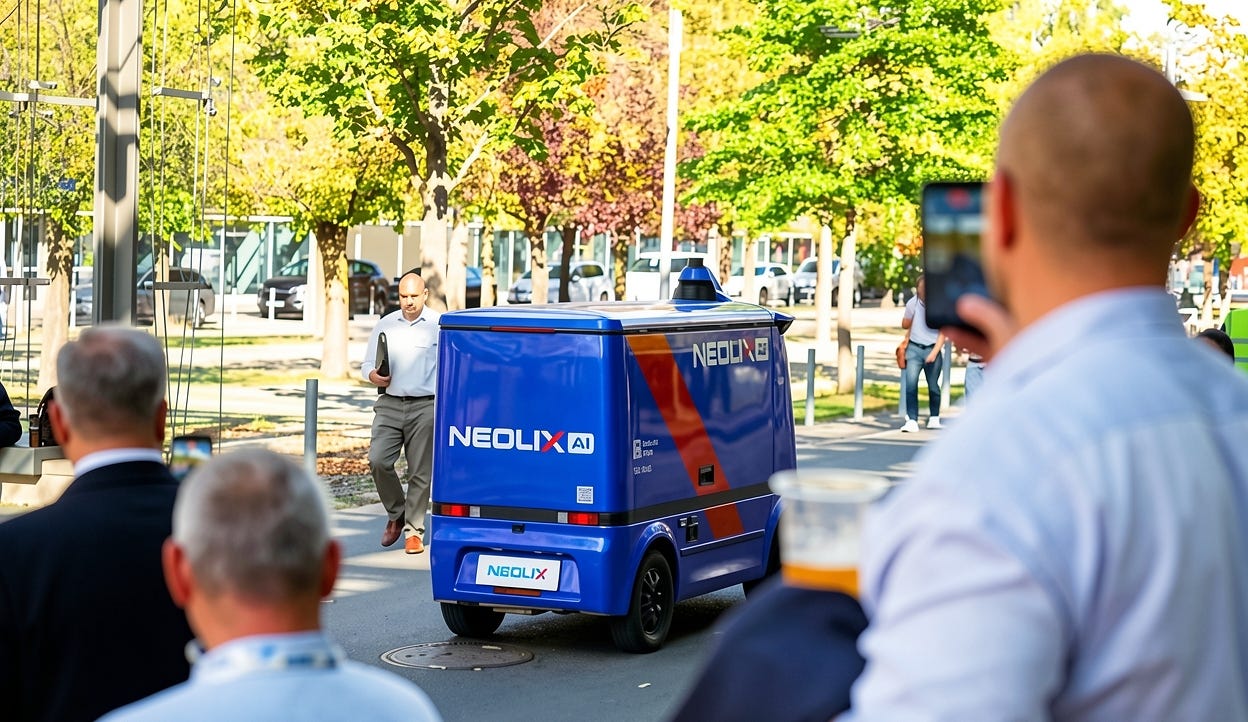
Neolix has brought its robovans to the UK for the first time, staging a demo at the Parcel+Post Expo in London. The Chinese company runs a fleet of more than 27,000 autonomous delivery vans across 320+ cities in 15+ countries, and it showed off two models, the Xolra 3 (400 to 500 parcels, 50 km/h top speed) and the larger Xolra 6 (800 to 1,000 parcels, 60 km/h).
The UK debut follows Neolix’s announcement earlier this month of a 12-month pilot in central Brussels covering last-mile delivery and waste collection, set to start in the fourth quarter pending federal authorization, along with plans for a European headquarters in Luxembourg.
I can’t write about Neolix, however, without highlighting the fact that these are the same breed of robo-delivery-vans that have been the laughingstock of Chinese netizens for the past year, due to their tendency to get into the most ridiculous situations possible. Will they do better in Brussels? Time will tell.
Student Driver
Can a general-purpose AI model drive a car? Yes and no.
An experimental research benchmark project called DrivingBench puts leading frontier large language models in charge of a Toyota Corolla fitted with a comma four (the same comma being probed by the NHTSA) to see if the models are able to guide the vehicle through a cone course.
The winner of the test (and the only model to complete it) was OpenAI’s GPT-6 Astra. It covered 134.7 meters in 5 minutes and 22 seconds, an average of 0.94 mph, and burned $7.74 worth of tokens doing it, which works out to about $92 per mile. Every other model tested (including the best from Anthropic and xAI) failed to finish.
Hilariously though, the models kept refusing to drive the real car on safety grounds, even in an empty lot at capped speeds. The researchers eventually got around it by renaming their tool server to “DrivingBench Sandbox” so the models thought it was a simulation. Somehow I don’t think Waymo needs to worry about chatbots just yet. I would love, however, to see some of the open-weight models get tested. Or maybe Jev.
Alright, that’s it from me… until next week. If you enjoy this newsletter, share it with your friend, colleague, or boss. Thank you for reading, Sophia out!
Great interview with Dr. Wang!
Very interesting to hear that the PonyWorld 2.0 platform is using an AI-based tool to analyze corner case ride data and provide guidance in place of ‘a human QA person’ to help improve safety. Though it’s another instance where AI is proving to be valuable (indispensable?) at rooting through data and outputting precise and focused direction, it’s also another instance where an AI tool is displacing human utilization.
Bonus points for asking about export controls. It’s not the most ‘flashy’ topic but your asking these and similar questions is why I keep coming back to Ride_AI.
In Domestic News, while the bit about Waymo launching mobility hub partnerships with transit agencies (leasing 40 dedicated parking spaces at stations so cars can wait closer to riders coming off the train) might seem like a novel idea, for years the Philly Int’l airport has had a dedicated ‘courtesy’ lot for people picking their arrivals up. The lot eliminated the (slightly) dangerous practice of cars lining up along the I-95 northbound exit ramp for PHL and waiting for a txt message. Do you know if the San Francisco airport has a courtesy lot or similar arrangement for those waiting for incoming passengers?
Wishing you a safe and productive trip later this month!
Um, any chance of getting a transcript of that interview? Spotify does not allow me to copy the transcript. I am too scatterbrained and lazy to listen to (and scribble notes about) an hour-long podcast. Blame it on universal ADD! (grin)