


This is the Ride AI newsletter: The most comprehensive weekly digest of news and intelligence at the intersection of technology and transportation.
Coming up, we cover Tesla’s Cybercab launch and everything that’s followed, Wayve and Uber’s driverless debut in London, and Zoox’s new airport service. But first, a few words on a fantastic AI event with an exclusive promo code for Ride AI readers, courtesy of our partner Runway.
Today’s Ride AI newsletter is brought to you by Runway.
Join us in San Francisco on September 30 for the Runway AI Summit. Industry leaders across autonomous vehicles, robotics and infrastructure come together for a day on how AI is reshaping the way intelligence meets the world. Hear from Wayve, Google DeepMind, Physical Intelligence, NVIDIA, Runway and more.

Get your tickets now with code RIDEAI30 for 30% off registration.
Top Story
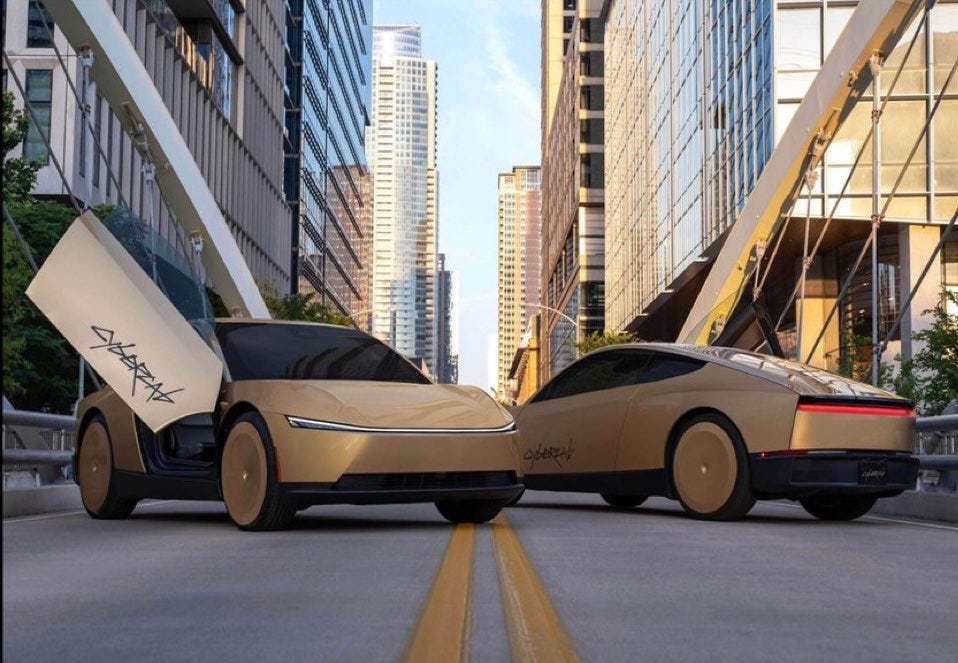
Tesla has opened its Cybercab robotaxi to public riders across Austin, the first commercial launch of its own purpose-built robotaxi with no steering wheel, no pedals, and no human safety monitor onboard. Bookings opened citywide on September 4, inside a geofence of roughly 264 square miles. Rides in the two-seat vehicle cost about 35% less than trips in Tesla’s existing Model Y robotaxi fleet, $7.77 versus $12.10 for the same route in one comparison.
Tesla unveiled the production Cybercab at an invite-only event in Austin the day before, confirming steer-by-wire and brake-by-wire hardware, a 22-inch center display, and a claimed drag coefficient under 0.20. Accessibility features include Braille labels on the door and emergency-stop buttons and seats set at wheelchair height (although more on Cybercab accessibility later). Tesla’s vice president of AI software said the robotaxi fleet has now logged more than 1 million miles of unsupervised driving, and that fully driverless service will expand to 24 hours a day next month once a new software build ships.
At the same time, The National Highway Traffic Safety Administration has opened an audit into Tesla’s self-certification of the Cybercab, questioning whether the vehicle meets federal safety standards despite lacking manual controls. However, Zoox faced a nearly identical audit after self-certifying its own steering-wheel-free robotaxi back in 2022, and didn’t win a federal exemption until July 31 of this year.
Domestic News
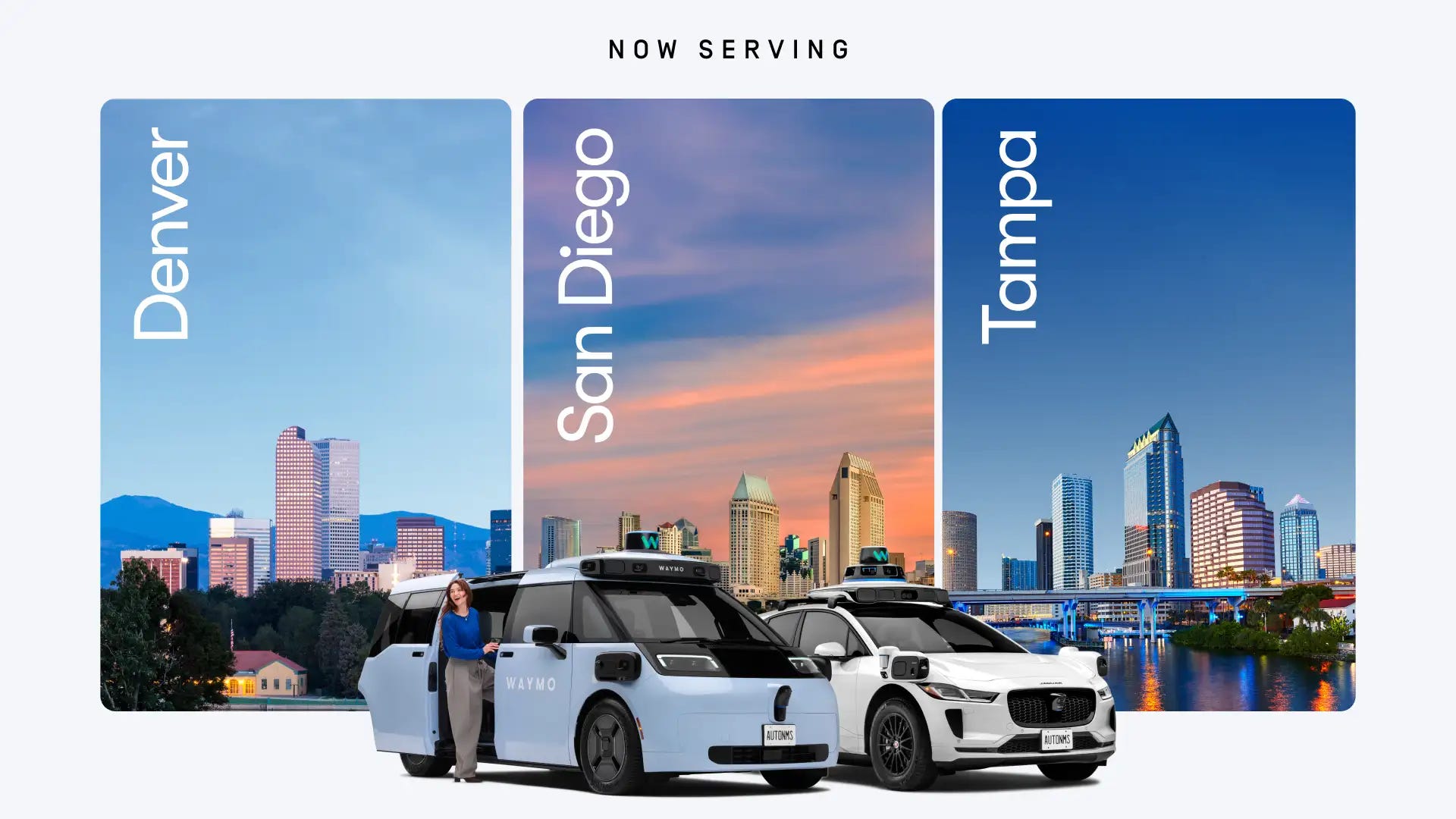
Waymo has opened public robotaxi rides in Denver, San Diego, and Tampa, bringing its number of operating regions to 14 US cities. Waymo says that tens of thousands of riders have already signed up in each new market, and that access will keep expanding gradually within each city as it works toward availability for all riders.
Zoox has begun picking up and dropping off riders at Las Vegas’ Harry Reid International Airport, the first fully driverless robotaxi service to operate directly inside a major US airport. The purpose-built robotaxi serves both terminals, with pickup and drop-off points near baggage claim, building on the paid rides Zoox started in Las Vegas on August 10.
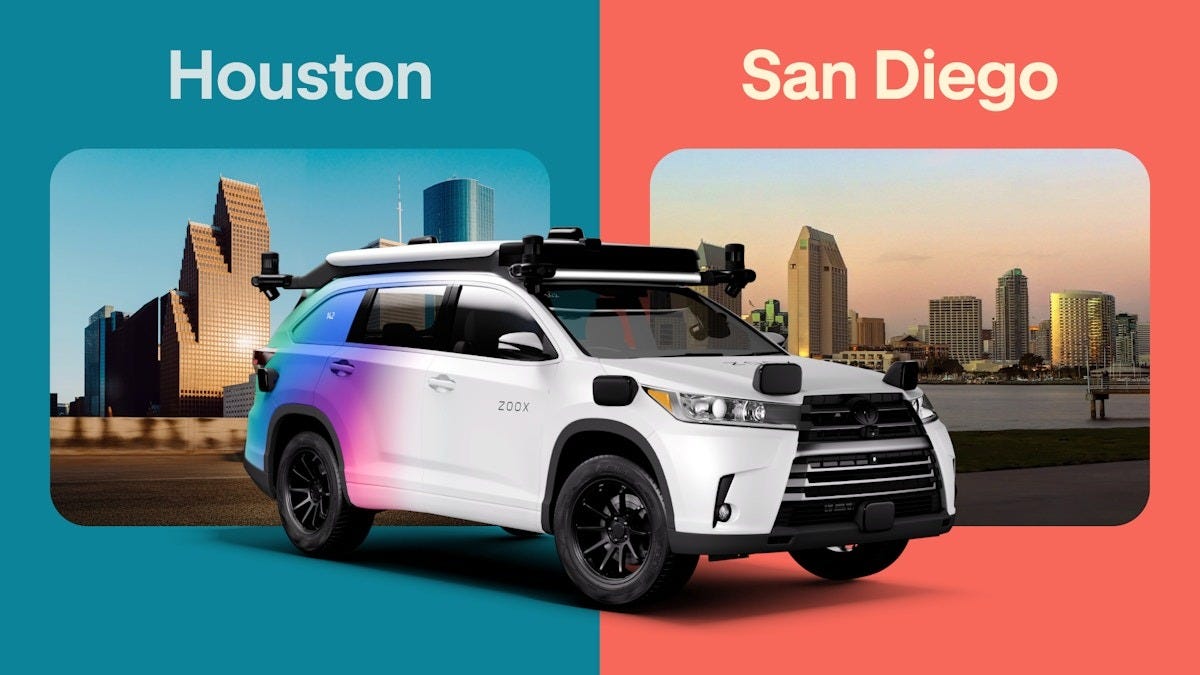
Zoox is also expanding its testing footprint to San Diego and Houston, bringing the total testing footprint to 12 US locations. The company says it picked Houston for its sprawling service-road network and severe weather, and San Diego for its coastal fog and heavy highway use ahead of future freeway operation. Zoox plans to open local depots and hire in both markets.
Uber is cutting about 3,300 jobs, 10% of its global workforce, as part of a restructuring meant to fund its push into autonomous delivery and robotaxis. CEO Dara Khosrowshahi said the company’s growth had brought “more layers, more coordination, more fragmented ownership,” and the changes cut management roles by 20%, shrink one and two person teams by nearly half, and eliminate positions more than seven layers from the CEO. Alongside the cuts, Uber is also consolidating its delivery and engineering teams and scaling back remote work, with most employees now expected in the office three days a week.
Motional and MIT have published a Nature paper introducing CW-Net, a system that translates a self-driving car’s internal decisions into human-readable concepts like “approaching stopped vehicle” or “close to cyclist,” aimed at cracking open the AI black box problem. Upon testing on Motional’s vehicles in Las Vegas, the system caught two issues invisible to standard monitoring. One car kept stopping near a traffic cone because its experimental planner was hallucinating a stopped vehicle rather than reacting to the cone itself, and a separate braking event for a cyclist turned out to come from a safety backup system instead of the main planner. Motional says the added interpretability resulted in less than 1% performance overhead. CEO Laura Major, a coauthor on the paper, had previous said that end-to-end AI alone “can get to a really good 80 to 90, maybe even 95 percent, solution, but that’s not good enough to remove a driver,” thus requiring extraneous systems like CW-Net.
Tesla’s Cybercab launched. Now what?
Tesla’s stock fell 6% on September 4, the same day NHTSA opened its above-mentioned audit. Investor confidence had seemingly shifted overnight, with the main question transforming from whether Tesla could launch a steering-wheel-free robotaxi to whether it can actually scale one. What gives?
Let’s start with the Cybercab itself. In a nutshell, it’s a purpose-built car with no steering wheel or pedals carrying paying passengers. This is a first for a company operating at Tesla’s scale, and an absolute triumph for Musk’s original vision of a self-driving car operating entirely on camera input. David Moss, who’s spoken at Ride AI’s own conference and contributed to this newsletter, rode the Cybercab for 63 minutes through Austin surface streets, a highway stretch, and hairpin turns, and called it the smoothest, most human chauffeur-like AV experience he’s had, ahead of both Waymo and Zoox. This aligns with my own experiences with the safety-monitored Cybercabs based on Tesla’s Model Y. His father Gary, who is blind, found real use in the car’s Grok voice assistant narrating trip and location details out loud, a fantastic win for accessibility.
Other parts of the rollout hadn’t gone as well, however, with people commenting on the vehicle’s design flaws. Tesla’s own accessibility ad showed a wheelchair user wheeling up to the trunk of the Cybercab, then miraculously standing up to stow his chair in the trunk and walking to the door. A solo wheelchair user has no way to actually get from the trunk to the door once the chair is packed away, an unfortunate oversight that the ad’s target audience was quick to point out.
Beyond the ad goof, David Moss ran his own obstacle tests, placing a banana and a hot dog in the door and trunk’s closing path to see whether Tesla’s sensors would catch them. Several clips riders posted of the butterfly doors making contact with boxes, other objects left curbside, and closing on people despite Tesla’s rider guide describing camera-based obstruction scanning, have gone viral. Reports of the butterfly doors opening wide enough to obstruct the flow of traffic the next lane over also abound, which makes me really wonder if that design had really been thought through for operating in dense, urban environments.
It’s important to note, however, that despite the hot dog testing and people intentionally jumping in the way of the Cybercabs, there have been no major injuries reported so far, small fleet size aside. NHTSA’s audit, mentioned above, really about whether Tesla’s paperwork holds up. Whether Tesla can actually scale the Cybercab into a Waymo-sized operation is the real question, though, to which I’m thinking yes… but with some caveats.
The biggest one is that Tesla’s robotaxi program has a track record of growing its map faster than its fleet. The service has gone from one city in June 2025 to seven metros today, Austin, Dallas, Houston, Miami, Orlando, Tampa, and the Bay Area, but the actual number of cars on the road per city barely grows once they are introduced. Take Austin, Texas, for example, where the Cybercab launched. According to Robotaxi Tracker (chart below), given a reasonable vehicle active rate on a one year timescale, active vehicles have remained relatively stable. This has only increased in recent days due to the Cybercabs arriving on Austin roads to prepare for the launch. Will we see a decrease in Model Ys on the road in response to the Cybercabs? Will the Cybercabs be effectively replacing the Model Ys to keep Tesla’s safety statistics in check? Only time will tell.
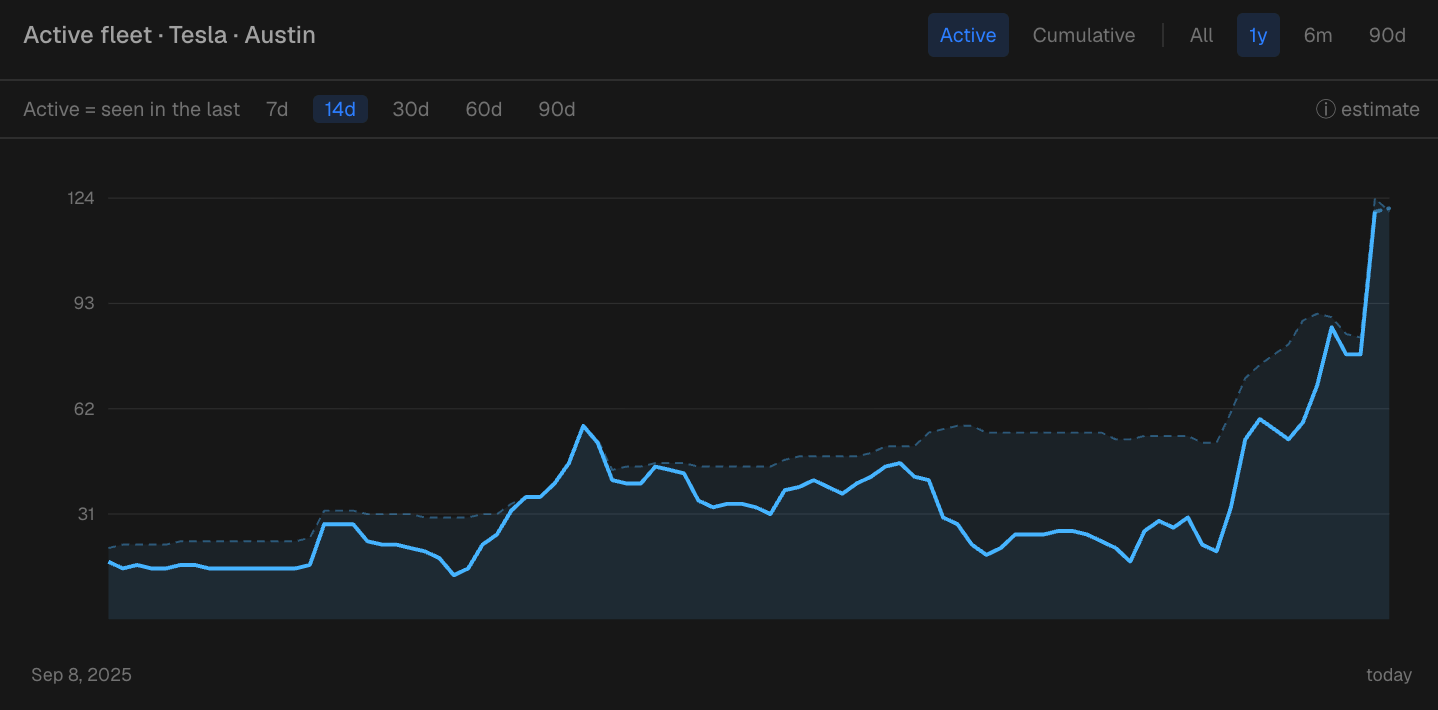
Waymo, for comparison, runs about 4,000 vehicles across 14 cities and delivers over 500,000 paid rides a week. Given the trends we see so far, until Tesla gets more confident with its Robotaxi program safety statistics, I expect the service area to keep expanding while the fleet numbers remain flat.
California is the highest hurdle. CPUC deputy executive director Pat Tsen has said Tesla is “not operating an autonomous vehicle service” in the state, since its cars run on SAE Level 2 systems with a person in the driver’s seat rather than the Level 3-plus classification California requires. Tesla’s only permit there is a charter-party carrier license, the same one a limo company gets, and an actual driverless permit would mean submitting quarterly trip data, location, passenger counts, vehicle miles, and stoppage events. Waymo, Zoox, and others are already providing and have been providing this data, but not Tesla. Why hasn’t Tesla, if the company is serious about demonstrating that it is running a safe service?
None of that makes Cybercab DOA, however. Any company betting itself on a steering-wheel-free, camera-only car and putting it into paid commercial service is doing something none of its rivals have. The car looks cool as well, questionable functional design choices aside. Beyond that, the efficiency engineering achieved by the various hardware teams at Tesla are incredibly impressive. But turning it into a real Waymo competitor is going to take a bigger, more serious fleet on the road, a cleared regulatory bar in states like California, and door sensors that actually work when influencers test them with bits of lunch.
If you’re interested in more discussion about the Cybercab, James Gross, our fearless leader at Ride AI, discusses the Cybercab and how marketers can think about autonomy in this Alephic podcast:
International News
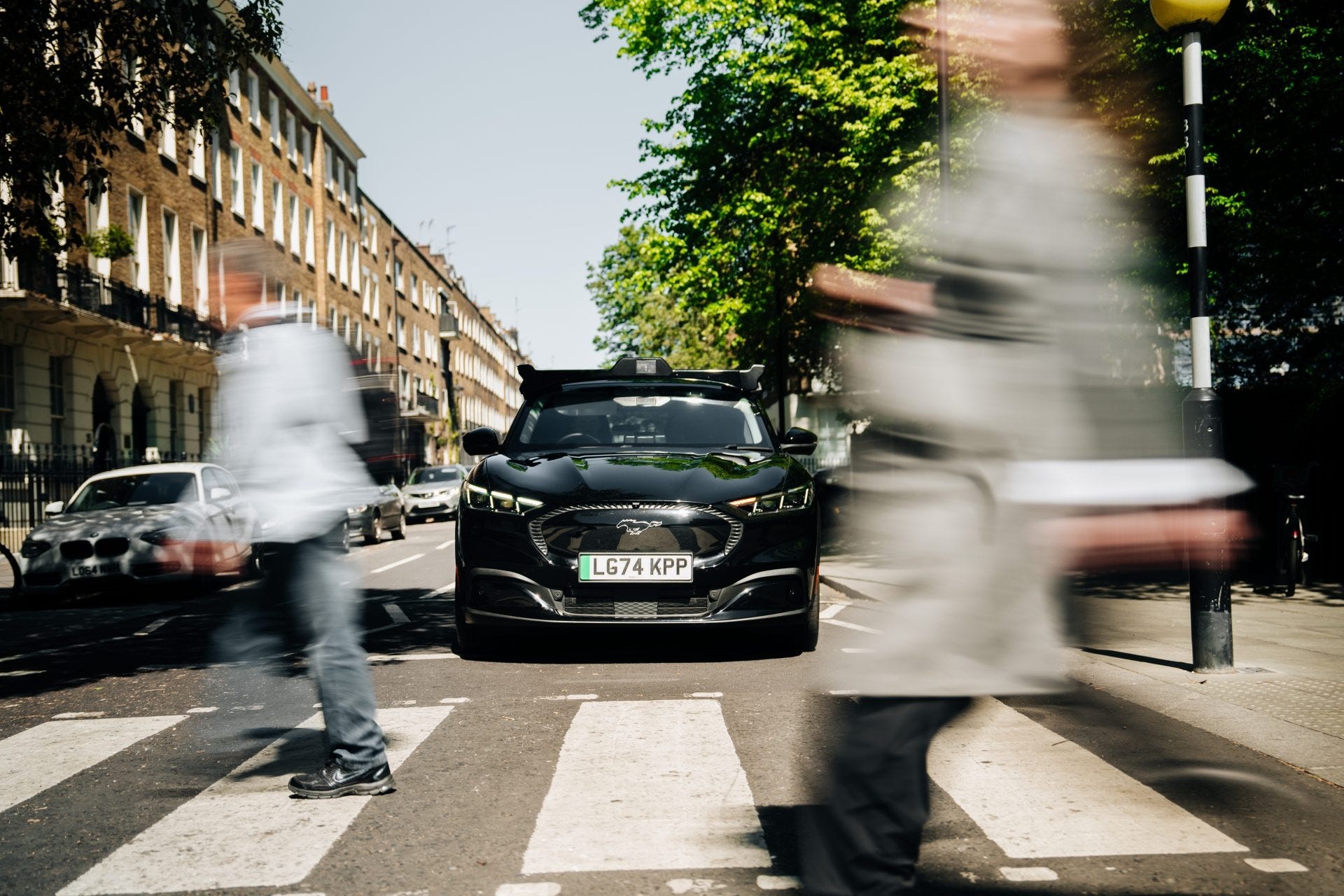
Uber and Wayve have launched the UK’s first public autonomous ride service in London, running all-electric Ford Mustang Mach-Es on Wayve’s Driver stack, with a licensed safety driver still on board for this first, supervised phase. More than 140,000 Londoners had already opted in through Uber’s app before launch. Wayve CEO Alex Kendall called London “one of the most complex driving environments in the world,” and the companies plan to expand the partnership to 12 markets globally, including Nissan Leafs in Tokyo later this year. UK transport secretary Heidi Alexander called it “a major milestone for the future of transport in London,” although black cab drivers might beg to differ.
Lost Relic
Someone spotted a 2024 Cruise Origin sitting on the Illinois Institute of Technology campus in Chicago, missing its sensors and looking like it hasn’t moved in a while.
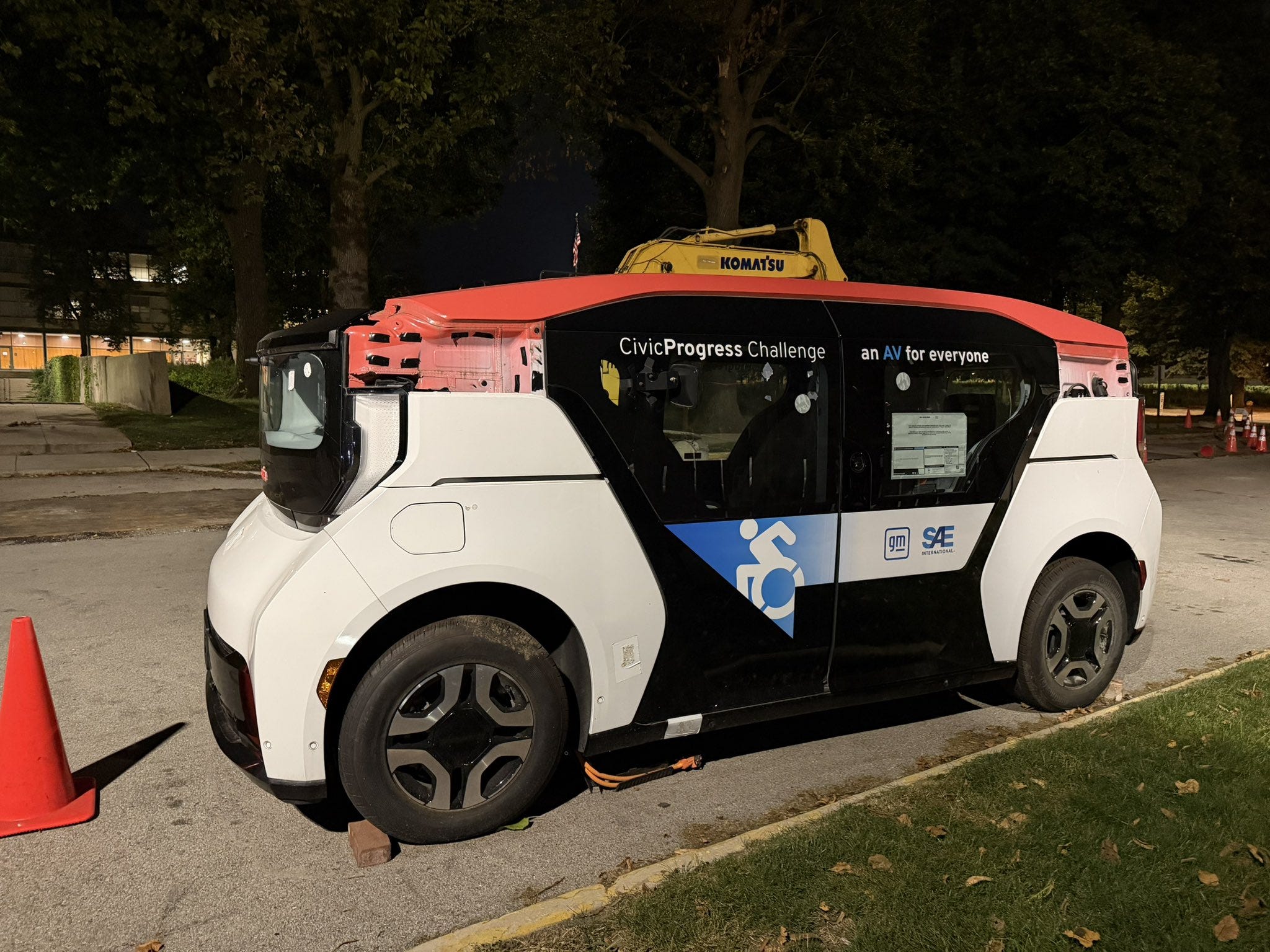
GM unveiled the Origin with Honda back in 2020 and built several hundred preproduction units before shutting the program down in 2024, shifting focus to modified Bolts, then folding Cruise into Super Cruise, its driver-assist system for personal cars. Here’s what it was supposed to look like back in its heyday of… 2024:
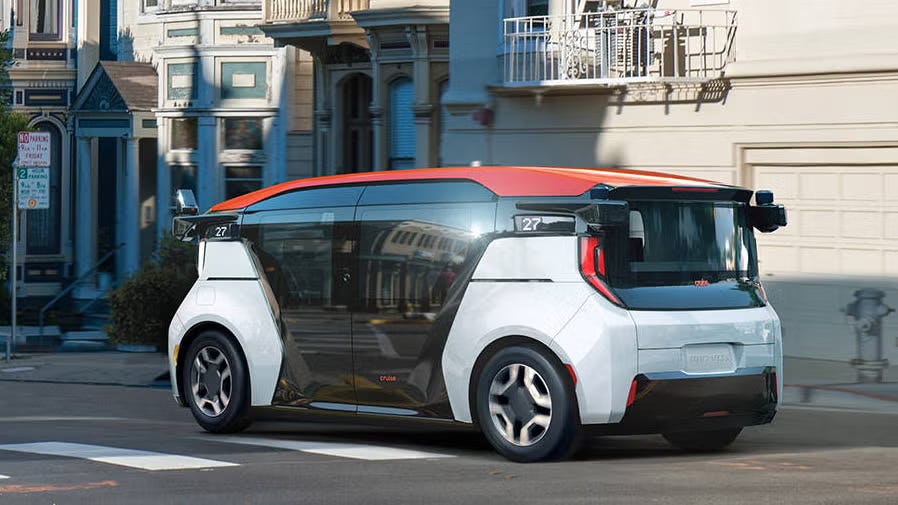
I actually saw it in person once when Cruise was filming around San Francisco. Neat concept.
Alright, that’s it from me… until next week. If you enjoy this newsletter, share it with your friend, colleague, or boss. Thank you for reading, Sophia out!
[SHARE BUTTON]