

Robotaxi Moneyball
On building Waymo in the aggregate, new AV regulations in California, and a mass stall in China

Welcome to the Ride AI newsletter: The most comprehensive weekly digest of news and intelligence at the intersection of technology and transportation.
Busy week, let’s get right to it.
Robotaxi Moneyball
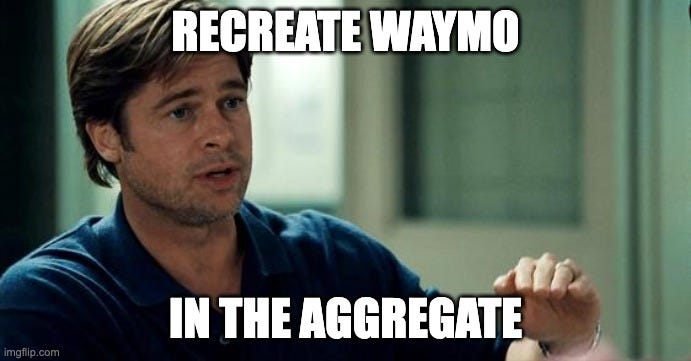
There’s an iconic scene in Moneyball where Billy Beane, fresh off losing superstar Jason Giambi to the Yankees, sits in a room with his grizzled group of old head ball scouts. As they suggest an inferior group of overpriced free agent signings, Beane delivers a beautiful quip:
“You’re still trying to replace Giambi, we can’t do it. Now what we might be able to do is re-create him in the aggregate.”
Somewhere, Brad Pitt smiled as Hertz and Uber announced a partnership to help scale Uber’s robotaxi and driver-led fleet operations. How can you not be romantic about strategic corp dev?
All told, here’s the “recreate Waymo in the aggregate” stack taking shape:
Uber is the distribution and the capital. The company now owns 11.5% of Lucid after a second $200M investment in April, bringing its total to $500M and its vehicle commitment to at least 35,000 Lucid Gravity SUVs.
Lucid builds the vehicle– the Gravity SUV, which received its robotaxi sensor suite in late 2025.
Nuro supplies the autonomy stack, powered by NVIDIA’s Drive AGX Thor, and now has 100 Gravity SUVs in its engineering fleet gathering real-world data across multiple U.S. cities. Uber employees can already hail one through the app in San Francisco.
And as of April 30, Hertz, through a newly created affiliate called Oro Mobility, handles the depot: charging, maintenance, repairs, cleaning, and staffing.
The obvious question here is whether four companies doing together what Waymo does alone is a structural advantage or a structural liability. It’s a version of the age-old consolidated tech stack vs. best of breed point solutions debate in enterprise software, now applied to AVs. Skeptics will rightfully point out that flywheels are generally built on data monogamy.
Uber is betting that a partnership model lets each company focus on what it’s actually good at, scales faster with less capital concentrated in one place, and gives the company optionality to plug in different AV vendors. Uber already has deals with dozens of AV companies globally, including Waymo itself. Hertz, for its part, is hedging its bets as well. Their press release notes that Oro will “explore expansion opportunities in 2027.”
The service is targeting a public launch in the San Francisco Bay Area by the end of 2026, using the Lucid Gravity. Nuro’s 100-vehicle engineering fleet is currently supervised; the driverless commercial service is still months away. Production of the modified Lucid Gravity vehicles begins in late 2026.
Domestic News
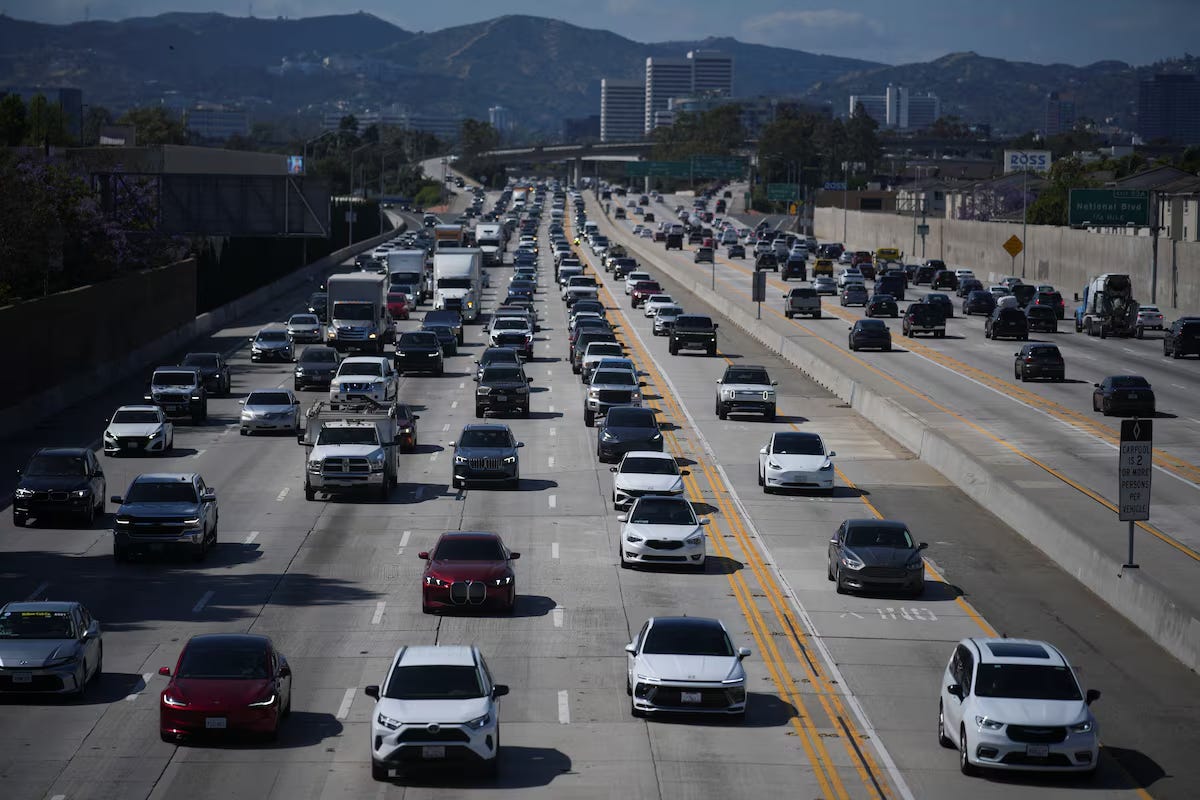
The California DMV adopted sweeping new AV regulations on April 28 — the most significant update to the state's framework in years, with two headline changes.
First, heavy-duty autonomous vehicles over 10,001 lbs can now be tested and deployed on California roads for the first time, opening the state's freight corridors to driverless trucks.
Second, starting July 1, law enforcement can issue traffic citations directly to AV companies when their vehicles commit moving violations. This closes a well-reported regulatory gap that went viral when a San Bruno police sergeant watched befuddled as a Waymo executed an illegal U-turn last September. The department provided a contender for dad joke of the year, quipping on Facebook that the citation books “don’t have a box for robot.”
Additional rules require AV operators to respond to first-responder calls within 30 seconds, comply with geofencing directives near active emergency zones, undergo licensing for remote operators, and report expanded safety data including immobilizations, hard-braking incidents, and collisions. DMV Director Steve Gordon called the package "the most comprehensive [AV regulations] to date in the U.S."
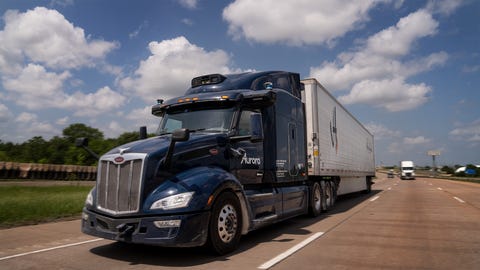
Aurora Innovation announced a memorandum of understanding with Hirschbach Motor Lines on April 30 for the refrigerated carrier to purchase 500 Aurora Driver-powered trucks, with deliveries beginning in 2027.
Aurora says the deal represents a multi-year revenue stream in the hundreds of millions of dollars. Hirschbach — a 90-year-old carrier based in Dubuque, Iowa with 3,000+ trucks — plans to run a hybrid model: Aurora handles the overnight long-haul runs, human drivers work the shorter regional routes that get them home daily.
CEO Richard Stocking called it "a quality-of-life investment for our people" as much as a business move. Aurora has already driven 800,000+ miles delivering 2,000+ loads for Hirschbach, including its 1,000-mile Fort Worth-to-Phoenix route.
The MOU is non-binding — binding agreements expected later this year — but AUR stock jumped 15%+ on the news anyway as of this writing. Aurora reports Q1 earnings tomorrow.
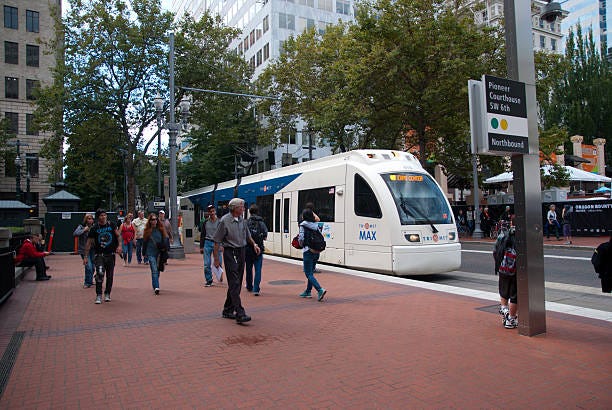
Waymo announced Portland as its next expansion market on April 28, beginning manual mapping of the city's streets immediately. Portland Mayor Keith Wilson offered an enthusiastic welcome, framing it around the city's Vision Zero goals.
Portland is a tricky little urban landscape, with an edge-case galore profile that differs from many Waymo markets. It is rain-slicked, bridge-heavy and its downtown grid runs MAX light rail in mixed surface traffic across 200-foot city blocks, with some of the highest cyclist density of any American city.
Waymo is currently in commercial service in 11 US cities and driving over 4 million miles weekly. No commercial launch timeline was given for Portland.
International News
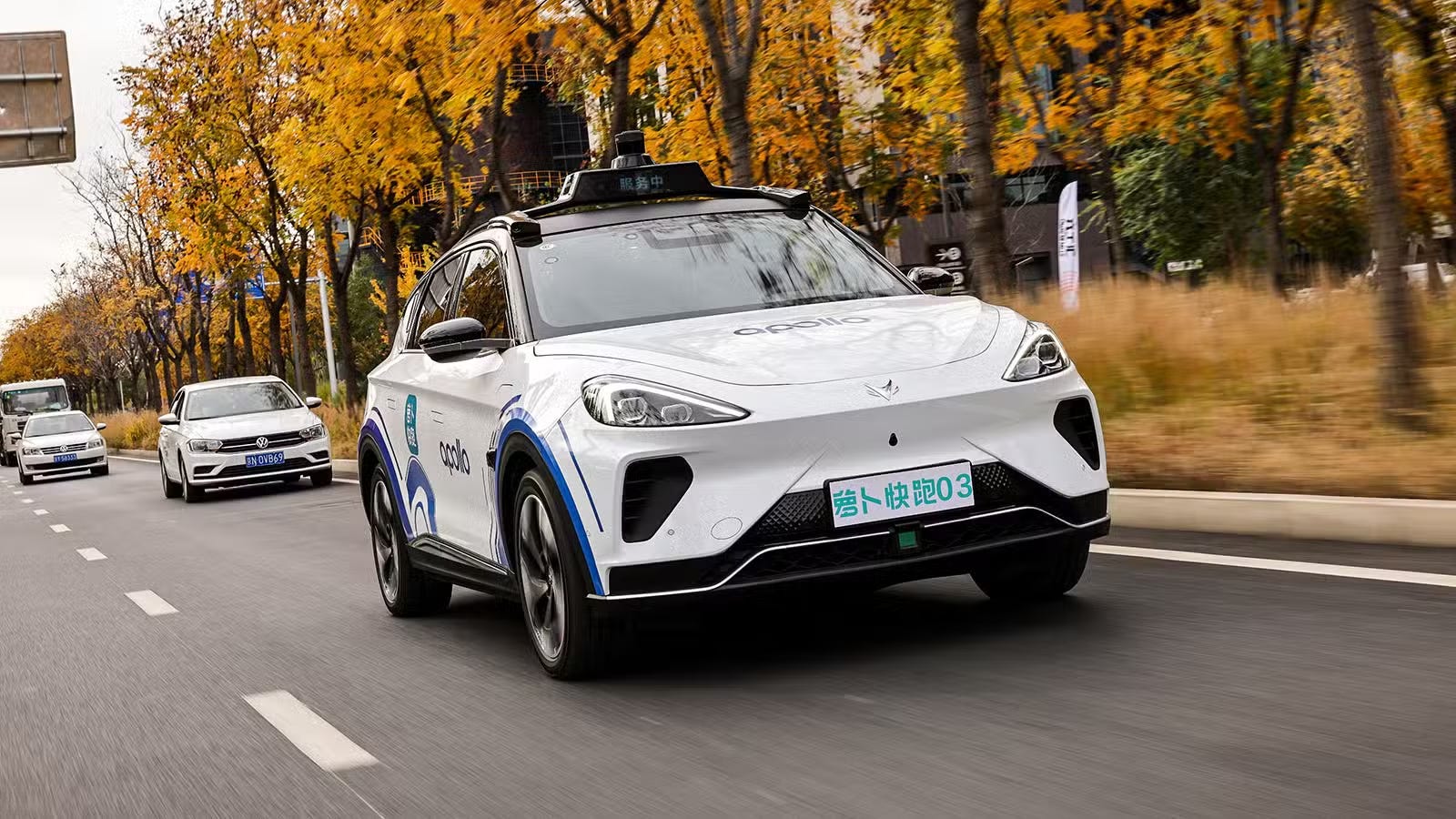
China suspended the issuance of all new autonomous vehicle permits this week, per Bloomberg, following the March 31 mass stall of over 100 Baidu Apollo Go robotaxis on the highways and overpasses of Wuhan. The incident trapped passengers for up to two hours, caused rear-end collisions, and triggered an investigation by three Chinese government ministries including the MIIT. The permit freeze means companies cannot add vehicles to existing fleets, launch new pilot programs, or expand into additional cities. The freeze is indefinite with no public timeline for resumption. Baidu’s Wuhan service remains offline.
Pony.ai and WeRide both issued statements noting their fleets are running normally and that they support “authorities’ efforts to ensure the highest safety standards.”
Pony.ai shares fell 9% April 29 on the news but have rebounded to be down ~4% week over week.
A Waymo test vehicle in London drove into an active police cordon on April 24 while officers were investigating a double stabbing in Harlesden. TikTok video showed the vehicle crossing police tape and lights before braking sharply. Waymo confirmed the car was being manually driven at the time, that the driver was suspended, and that their analysis suggests the vehicle would have stopped in autonomous mode.
Waymo is targeting a commercial launch in London around September, pending UK regulatory approval.
A few more quick hits…
Tesla’s unsupervised Robotaxi fleet hit 25 cumulative verified vehicles as of April 30, per Electrek, covering Austin (19), Dallas (3), and Houston (3). First real growth after months of near-stagnation. For context: Waymo operates 3,000+ vehicles completing 500,000+ trips weekly. On the Q1 call, Tesla confirmed the large-scale commercial rollout is tied to FSD V15. Musk described V15 as a “major architectural improvement” targeting superhuman reliability with the commercial scale-up now explicitly targeting end of 2026 or early 2027.
Tesla FSD V14.3.2 rolled out widely last week (April 28), hitting ~15% fleet saturation within 24 hours. The headline architectural change: a single unified AI model now powers Actually Smart Summon, FSD, and Robotaxi simultaneously. This is the first time all three autonomous modes share the same underlying system.
Einride filed its Form F-4 with the SEC on April 22, advancing its $1.35 billion SPAC merger with Legato Merger Corp. III toward a NASDAQ listing under ticker ENRD in Q2 2026. The Swedish autonomous EV freight company has $333M in gross proceeds lined up including an oversubscribed $113M PIPE.
Illinois Teamsters Joint Council 25 and the Labor Alliance for Public Transportation launched a formal coalition this week to block SB3392/HB5103, the state’s Autonomous Vehicle Pilot Program bills. Waymo began Chicago testing earlier this year.
Apropos of nothing, I started my career as an investigative journalist in Chicago investigating how a portion of every cab fare to O’Hare once went to funding a tiny suburb with links to organized crime.
That’s it from me… Sophia’s back next week. If you enjoy this newsletter, share it with your friend, colleague, or boss. Thank you for reading.
-Mike