


This is the Ride AI newsletter: The most comprehensive weekly digest of news and intelligence at the intersection of technology and transportation.
This week’s issue is a little different. I recently spent time traveling through China and tried just about every piece of autonomous tech and robotics I could get my hands on. What I saw left me alarmed, and I’ve written it all up, with photos and videos from the trip, in an editorial in the middle of this issue. But first, some industry news.
Top Story
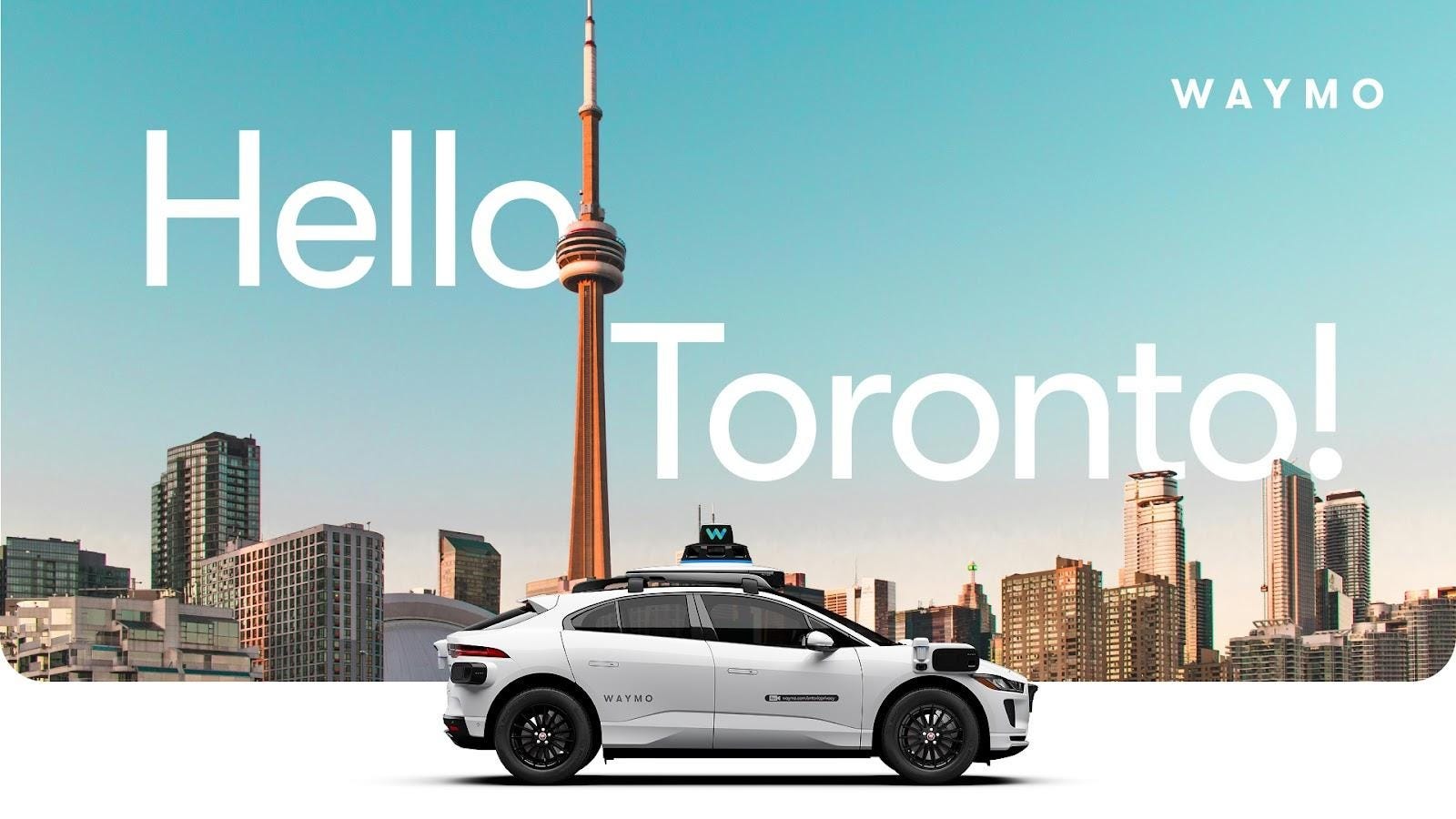
Waymo is heading to Toronto, its first city in Canada, with the goal of welcoming its first riders in 2028. Waymo has been approved to join Ontario’s automated vehicle pilot program, and its cars will start driving manually around the city in the coming days to build HD maps. Testing with safety drivers will come after that.
Toronto-based Element Fleet Management will handle fleet management for the service, and Waymo says the two will add “hundreds” of local jobs over time in maintenance, validation driving, and customer service. Waymo already has a couple of Canadian ties, with the Canada Pension Plan Investment Board as a long-time investor and Magna as its manufacturing partner. Toronto is the latest addition to Waymo’s international tour after London, Munich, Tokyo, and Singapore.
Between Toronto and the employee-only driverless rides in Detroit I wrote about last week, Waymo is clearly getting serious about winter. It’s really no joke. The company says it’s done a bunch of winter testing, but snow, slush, and salt-covered sensors are still one of the bigger open questions for sensitive autonomy hardware, so I’m interested in seeing how this plays out when the weather starts getting colder.
Back in the US, Waymo has opened its service to everyone in San Antonio, San Diego, and Tampa, so riders in all three cities no longer need to join a waitlist. San Antonio’s service area includes the airport. Waymo has also started serving Nashville International Airport for select riders, with pickups and drop-offs at the Ground Transportation Center. That makes BNA Waymo’s fifth airport. A now-deleted post from a Waymo employee also seemed to show a Waymo dropping off curbside at SFO, so curbside testing seems to also be ongoing there.
Domestic News
Rivian’s point-to-point driving will launch as an invite-only beta, and owners who get in will have to sign an NDA. The Autonomy Early Access Program starts in late 2026 for select R1 Gen 2 and R2 owners who pay for Autonomy+, with a broader rollout in 2027. Rivian will choose testers based on how much they use its driver-assistance features and their recent safety record. Testers have to use the features every week, log issues, and fill out monthly surveys, and they don’t get paid.
The first version is hands-off but eyes-on, and eyes-off driving has slipped to 2027, a year later than Rivian first said. Rivian is also eyeing licensing its tech to other brands, autonomy stack included, and expanding its joint venture with VW to cover AI and autonomy.
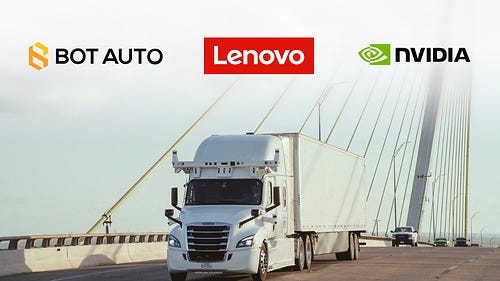
Bot Auto expects its self-driving hardware to cost $50,000 per truck, after picking Lenovo’s AD1 computer, built on Nvidia’s Hyperion platform, for its Class 8 trucks. The AD1 goes into Bot Auto’s trucks starting in the first quarter of 2027. Bot Auto says the $50,000 figure, which covers compute and sensors, is three to eight times less than competing systems. The Houston company now hauls about 350 loads a month across Texas, and its revenue grew 270% from May to August. It ran its first commercial load with nobody on board in April.
Waabi has also partnered with carrier Warrior Logistics, which has added a fleet of Waabi-powered trucks to haul its customers’ freight between Dallas and Houston. The trucks carry food and beverage, consumer goods, and other freight. Waabi says its load volumes on that route have grown more than 80% this year.
Zoox has leased more than 350,000 square feet of industrial space in Hayward, California, more than doubling its footprint near its robotaxi factory there. The two buildings sit next to the 220,000-square-foot production facility Zoox opened last June, and the lease is part of its push to scale up production.
A string of autonomy executive changes and departures happened this week, as Uber’s head of autonomous mobility and delivery is leaving the company, the latest in a string of departures from Uber’s AV division this year. Sarfraz Maredia, who has been at Uber for more than 12 years, will leave on November 16 for a company outside transportation. His responsibilities will be split between Samarth Kejriwal, who runs driverless vehicle operations, and Aaron Emrich, who heads autonomous delivery.
Guy Peterson, who ran business development for Uber’s autonomous partnerships, joined Rivian’s micromobility spinoff Also this month, and the unit’s head of legal left for Bedrock Robotics in June. Uber has committed more than $10 billion to AVs over the next few years, but its partnerships with Waymo and Serve Robotics both fell apart this year, and it cut about 10% of its workforce last month.
Nuro has named Rajiv Bhatia its chief product officer, ahead of the launch of its robotaxi program with Lucid and Uber. Bhatia previously led product at Roblox and Lyft’s rideshare business. He’s Nuro’s second senior hire in five months, after a new CFO in May.
The Lucid Gravity robotaxi is still targeted to launch in the Bay Area before the end of the year, and several engineering vehicles were spotted around Nuro’s Mountain View headquarters last week. The program calls for at least 35,000 vehicles globally over the coming years.
Minneapolis’ City Council has failed to override the mayor’s veto of an ordinance that would’ve required a human driver in every robotaxi. The council passed the ordinance 7-6 on October 1, and Mayor Jacob Frey vetoed it the next day. The override fell two votes short. Four council members have already restarted the process to pass new robotaxi rules.
In DC, the robotaxi bill I wrote about last week is headed for a committee vote, possibly by Thanksgiving, despite opposition from Councilmember Janeese Lewis George, who’s expected to be DC’s next mayor. Lewis George won her primary with union backing, and unions are organizing against the bill. If it clears committee, a full Council vote could come in December. The bill would cap each operator at 200 vehicles at first and hold off commercial service until 2028.
NHTSA is weighing a probe into Tesla’s robotaxis speeding through school zones, after receiving a defect petition on September 23. The petition covers 2026 Model Ys and Cybercabs running Tesla’s automated driving system, and alleges they exceed posted speed limits in active school zones. NHTSA hasn’t decided yet whether to open a formal investigation.
Editorial: I tried every Chinese autonomous technology. None impressed me.
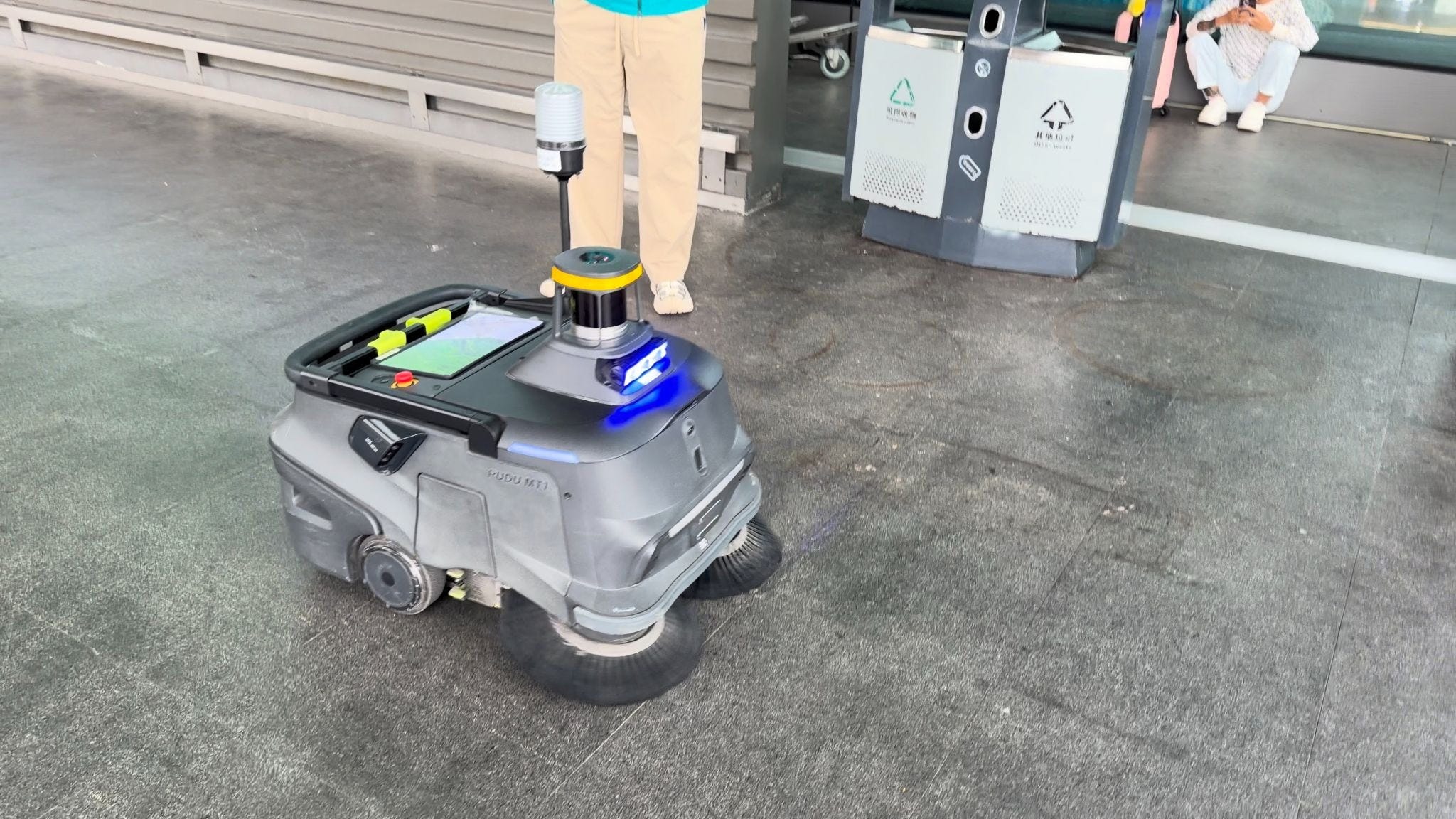
Upon landing in Shenzhen at around 1 a.m. on September 30th, I didn’t even make it out of the airport before I passed an autonomous floor cleaner and a self-driving wheelchair. That pretty much set the tone for the next two weeks, which took me from Shenzhen to Chongqing, Chengdu, Hangzhou, and finally Shanghai.
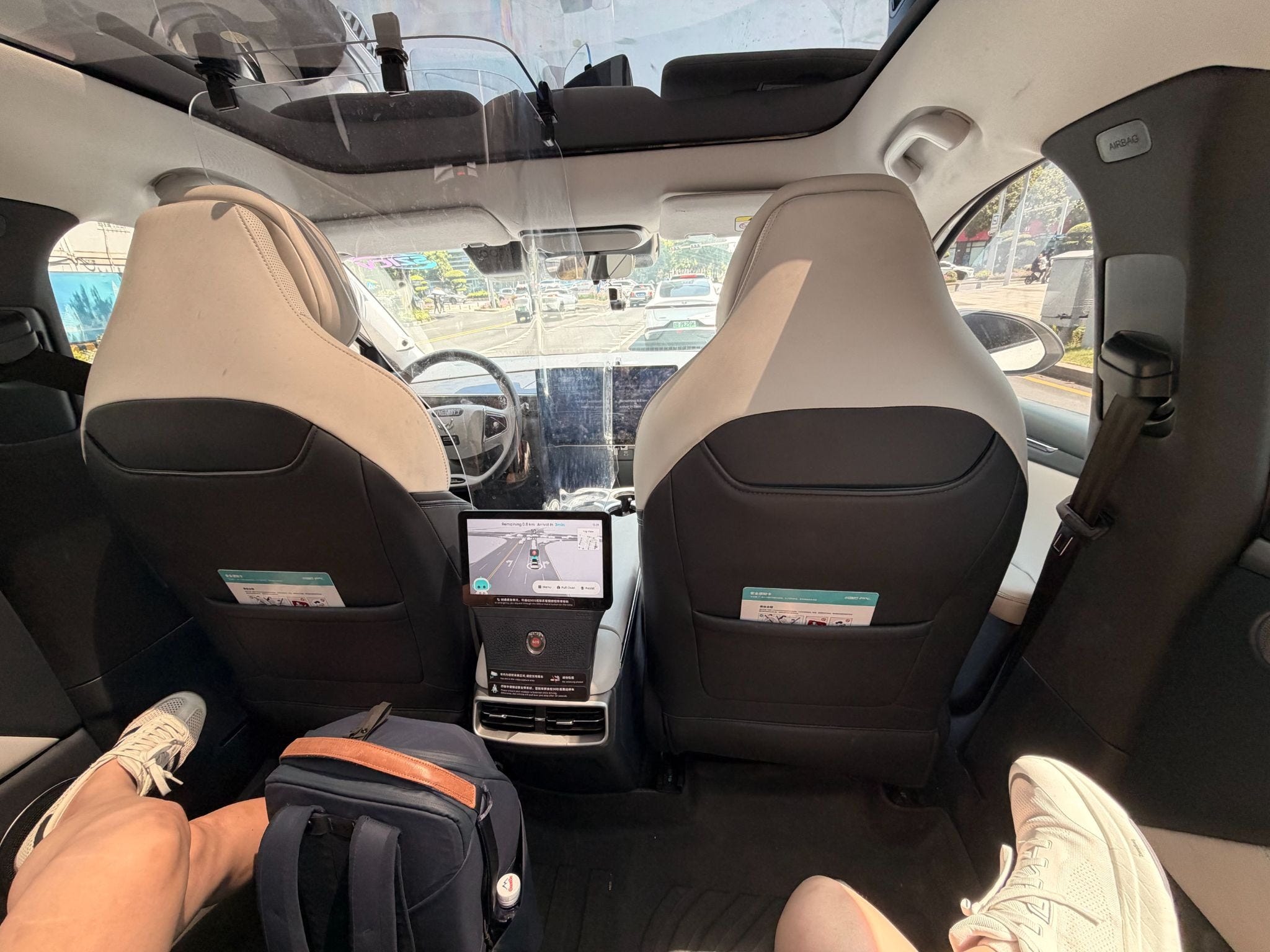
My first order of business was trying Pony.ai’s 7th generation robotaxi. In one of my previous videos, I rode Pony’s 5th generation car, a hybrid Lexus, and called it the most aggressive robotaxi I’d ever been in. This time, I rode the 7th generation, built on the GAC Aion V, on a loop around Pony’s offices on the west side of Shenzhen, near the airport, and had a completely different experience. The car was calmer, much less aggressive off the line, and generally handled itself way smoother. The interior was also a big step up, with more comfortable seats and a voice assistant. It’s not at the level of massaging seats or anything fancy, but general passenger amenities are much better. I’ll have a full video on the ride soon over on the Ride AI YouTube channel.
After the ride, I spent about half an hour with Pony’s display of its Gen-7 hardware, the platform that runs all of the autonomy. I got to see the actual open board, with its four Nvidia DRIVE Orin X chips and the liquid cooling system. More on that in the video too.
Once you know what to look for, autonomy is everywhere on China’s roads. Autonomous delivery vans are the most common. They’re about half the width of a normal car, but they still drive down the middle of the lane, and their boxy shape makes them easy to spot. Autonomous road cleaners are almost as common, mostly from WeRide. I did catch a couple of the delivery vans behaving not so great. Then again, almost everyone on Chinese roads drives that way, so nobody seemed too bothered. Some of that assertiveness might even be necessary, because traffic works very differently there. To give you an idea of how different the roads can be, there are left turn lanes on the far right side of the road, away from the center divider.
The robots aren’t limited to the roads either. At all of the hotels I stayed at throughout the trip, room deliveries (such as in the case of food deliveries) arrive by robot. These robots are able to navigate the hotels completely on their own, navigating corridors, avoiding people and obstacles, calling elevators, and unlocking doors autonomously. Right after the Pony ride, we went to a mall where huge Roomba-style floor cleaners were spiraling around the floors alongside the human cleaning staff. Across the street was Shenzhen’s Talent Park, where Meituan (Chinese Uber Eats) runs drone deliveries to a food locker in the park.
Contrary to the way high profile drive delivery services work in the US, the Meituan drone delivery service is centered around food lockers. Each drone flies in, descends, and centers itself on a landing pad on top of the locker. A gantry then closes in on its legs to lock it into an exact position. Then, a robot arm grabs the bag from underneath the drone and lowers it into the locker, where it gets slotted into a compartment for pickup. The whole handoff, from landing to takeoff, takes about half a minute. Then the next drone comes in as the first one takes off, and the whole process repeats. I sat there for close to an hour watching what looked like a never-ending line of drones. Most orders were small and light, like drinks from tea chains, plus a lot of KFC, which seems to be making a big comeback in China.
However, the conclusion I came to was that while neat at first blush, the system was loud. These are standard multirotor drones, the same you’d be able to buy off the shelf, and you can really hear them coming and going one after another. It made me understand why Zipline lowers a small delivery pod on a tether while the actual drone stays high in the air. Zipline’s solution is much, much quieter. Drones that come down low to drop a package, like Amazon’s, kick up a lot of noise and wind, and we’ve seen some oopsies where packages get blown around and into inconvenient places, like pools. Meituan’s system works, and it works at scale. They’ve solved the wind issue by landing the drone higher up on a specialized platform. But sitting next to it still isn’t the best auditory experience.
I kept seeing the same thing everywhere I went. By the time I flew from Chengdu to Shanghai, a week and a half into the trip, the floor sweeping robots working outside the departures level of the Chengdu airport were so old hat that I’d stopped noticing them. Restaurants have automation too. A lot of kitchens no longer have someone standing over a wok. They use an automated rotating pot with little ridges inside that flip the food as it spins. My friends tell me that that’s how a lot of stir-fry gets made now.
That’s something I keep coming back to. China is very good at taking technology that mostly already exists and iterating on it extremely fast. Working this way, however, means the user experience isn’t always as good as it could be, and there were many times that things worked so poorly, I just had to stop and ask, “...why?” The aforementioned hotel room delivery robots, for example, while able to avoid people, often end up bullying the people it’s meant to avoid instead. Multiple times, I’ve tried to exit an elevator, only to be pushed back into the elevator by a delivery robot on a mission and be taken to the floor the robot was going to. Avoiding people seems only limited to convenient places it seems, not the narrow confines of the elevator door.
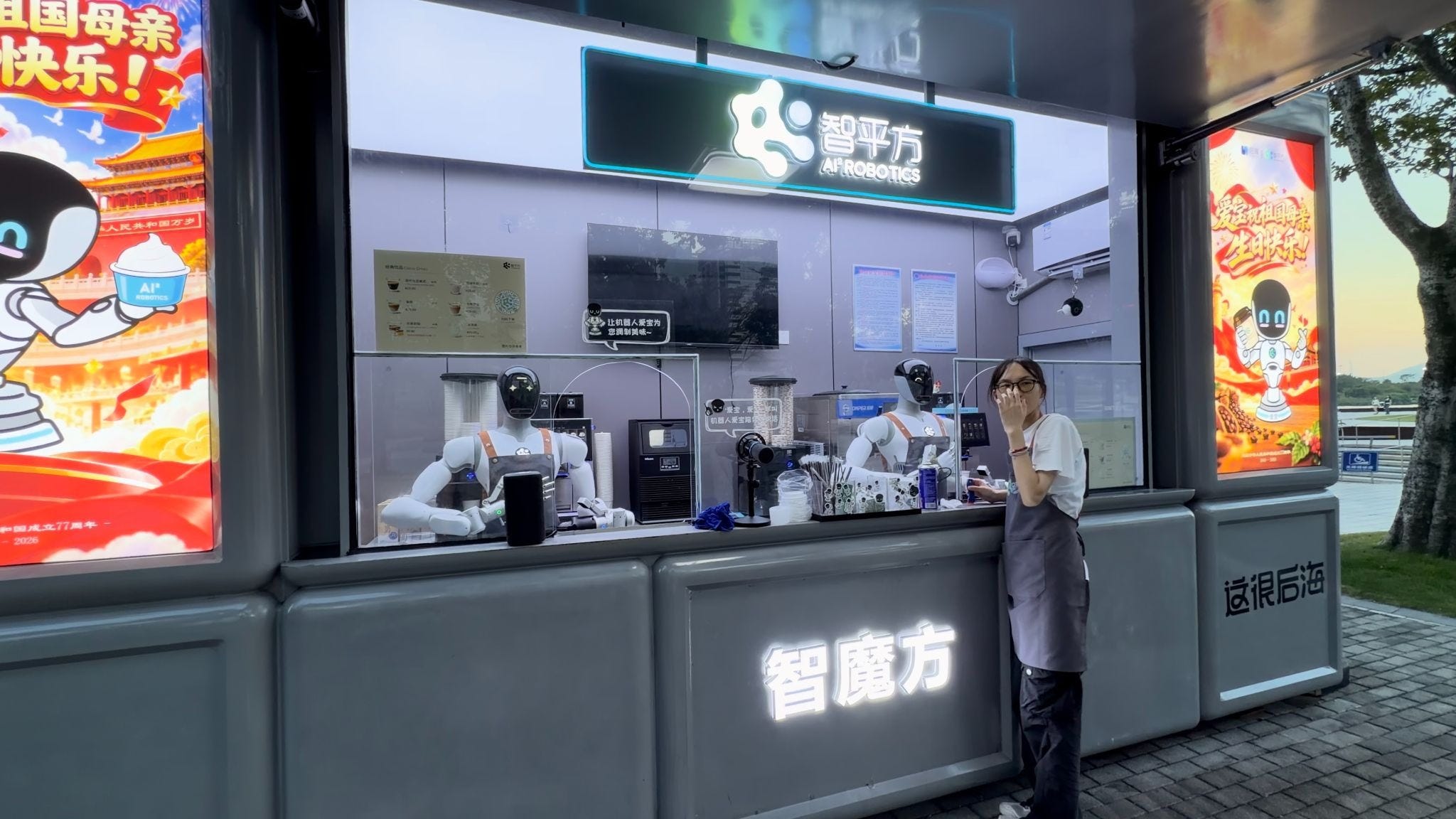
The same drone delivery park has a coffee shop where a half-humanoid robot makes your coffee. These types of robot shops are all over China now, and I saw them in Shenzhen, Chongqing, Chengdu, and Shanghai. They range from a single robot arm doing everything to a full humanoid that rolls around the shop, pulls things off shelves, and uses both hands. All of them are slow, since the robots aren’t built to move fast. And all of them have at least one human, sometimes many more, watching the robot and making sure nothing goes wrong. When something does go wrong, the staff are quick to pull a curtain so you can’t take a picture of the failure. The fact that there’s always a curtain ready is pretty funny to me, and shows just how early stage these robots really are.
Some shops have a camera and a speaker out front, and the robot calls out to people walking by. If it recognizes you’re a woman, it’ll often call you “beauty” and invite you over for a coffee, which while funny, is a little creepy at the same time. Chinese companies like to give their robots a personality. It often comes off a bit weird, but it’s just part of daily life there.
Also in Shenzhen, I stumbled on a store from Qiyuan Robotics, the consumer robot brand of materials company Swancor, which is building humanoid robots meant to be companions for kids. Its Q1 is about 88 centimeters tall, a little below waist height, and weighs about 60 pounds. The highlight is that you can take the robot by the hand and lead it around, and it’ll trundle along after you like a kid would. There’s an LLM-based chatbot built in that mostly worked, though not so well in a noisy store. You can tell it to wave at someone and it will. You can also pick it up by a handle or under its arms, even while it’s standing, and it won’t struggle. Set it back down and it goes right back to standing. It’ll also breakdance, full-on down on the floor. It doesn’t pay much attention to its surroundings while it does, so you could get whacked by a stray arm.
Qiyuan’s other robot, the T1, has wheels for feet, rolls much faster, and transforms into a walking robot dog. I was very surprised the first time I was the bot transform.
The Q1 starts at 19,999 RMB, or about $2,800, and the T1 Pro goes for 29,999 RMB, or about $4,200. Maybe that makes sense for a well-off parent who wants to get their child a robot friend so they’re less lonely, but I think that would still be a pretty lonely child. As a piece of consumer hardware, though, it looks impressively complete. That said, I’d love to actually test one for longer than half an hour to see whether it really is, as while I was at the store, a lot of the demos kept failing. Whether this was due to the environment or some other factors, I’m not sure, but this type of technology is a good snapshot of where the Chinese robotics industry thinks this is all going. Companies like Qiyuan are great at following the Xiaomi playbook of scaling breadth. They can bring prices way down and quality way up for the price, even if there isn’t much depth to what the robots can actually do yet.
Shanghai had the most over-the-top example. There’s a Dairy Queen on Wujiang Road built around Sharpa’s North robot, a wheeled humanoid with two arms and articulated fingers that makes Blizzards, and it’s absolutely the centerpiece of the store. In fact, it’s such a centerpiece that there’s a replica of it stuck to the wall outside the store.
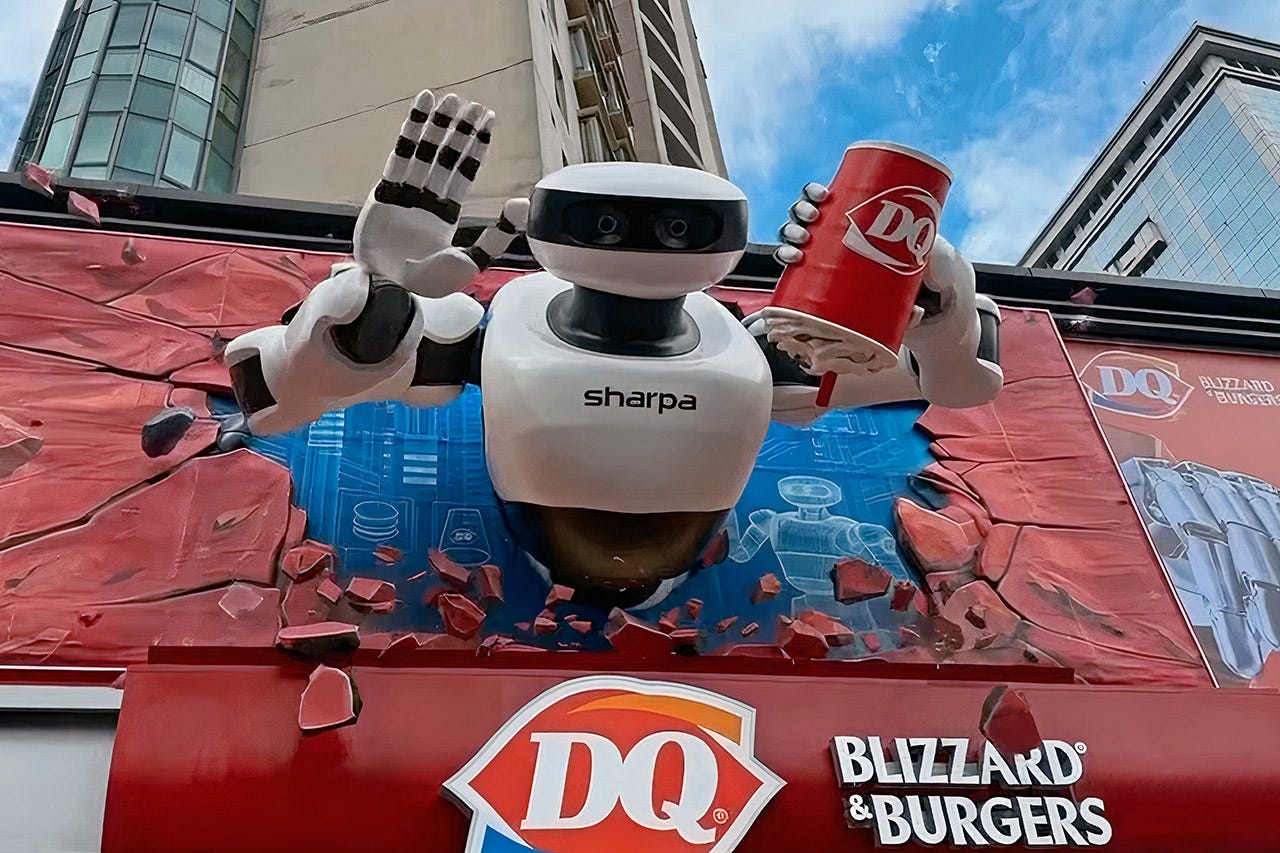
Sherpa takes your order, grabs a cup, and works through 55 steps of individually trained policies to finish your Blizzard. The cherry on top at the end is Sherpa turning the Blizzard cup with the ice cream in it upside down to show that the Blizzard was properly made and not too melty. A human can make one in a couple of minutes. Sherpa took about eight. Five staff members stood around the robot the whole time making sure it didn’t drop the cup or the ice cream, then cleaned up after it once it was done. An impressive tour-de-force of hardware and software working together to finish a task to be sure, but far from a complete, single policy, long-horizon task trained on a world model like many companies, both in the US and China, have been doing for over a year by now.
So the recurring theme is really this: China has an enormous amount of automation, but most of it is low-stakes automation we already know works. We have Roombas. Scale one up and you get the floor cleaners in every Chinese airport. For all the noise in the news about how far ahead China is because of how much automation and robotics it has, a lot of that is possible because the automation isn’t very deep. We could do most of it too, but Western culture is much more concerned about automation taking over human jobs, whereas in China, while the concern isn’t entirely absent, it’s seen as much more of a fact of life.
But in fact, robots haven’t replaced human jobs in China the way we keep hearing. Even with all that robotics and manufacturing scale, there are still people everywhere, usually standing right next to the robots. Most of the automation I saw isn’t deep enough to meaningfully replace human labor, at least not yet, and most of the robots in public life do very specific, narrowly defined task domains, with more complex tasks still keeping the human in the loop. At the same time, you can see where this is heading. So no, unlike a lot of the people handwringing about who’s going to “win” the robotics race, I’m not so sure there really is that much to be concerned about. There’s a lot of repetitive, simple work that can be automated away, and China is simply automating it faster, more broadly, and more visibly than anywhere else. Whether the automation is useful is another matter entirely.
International News
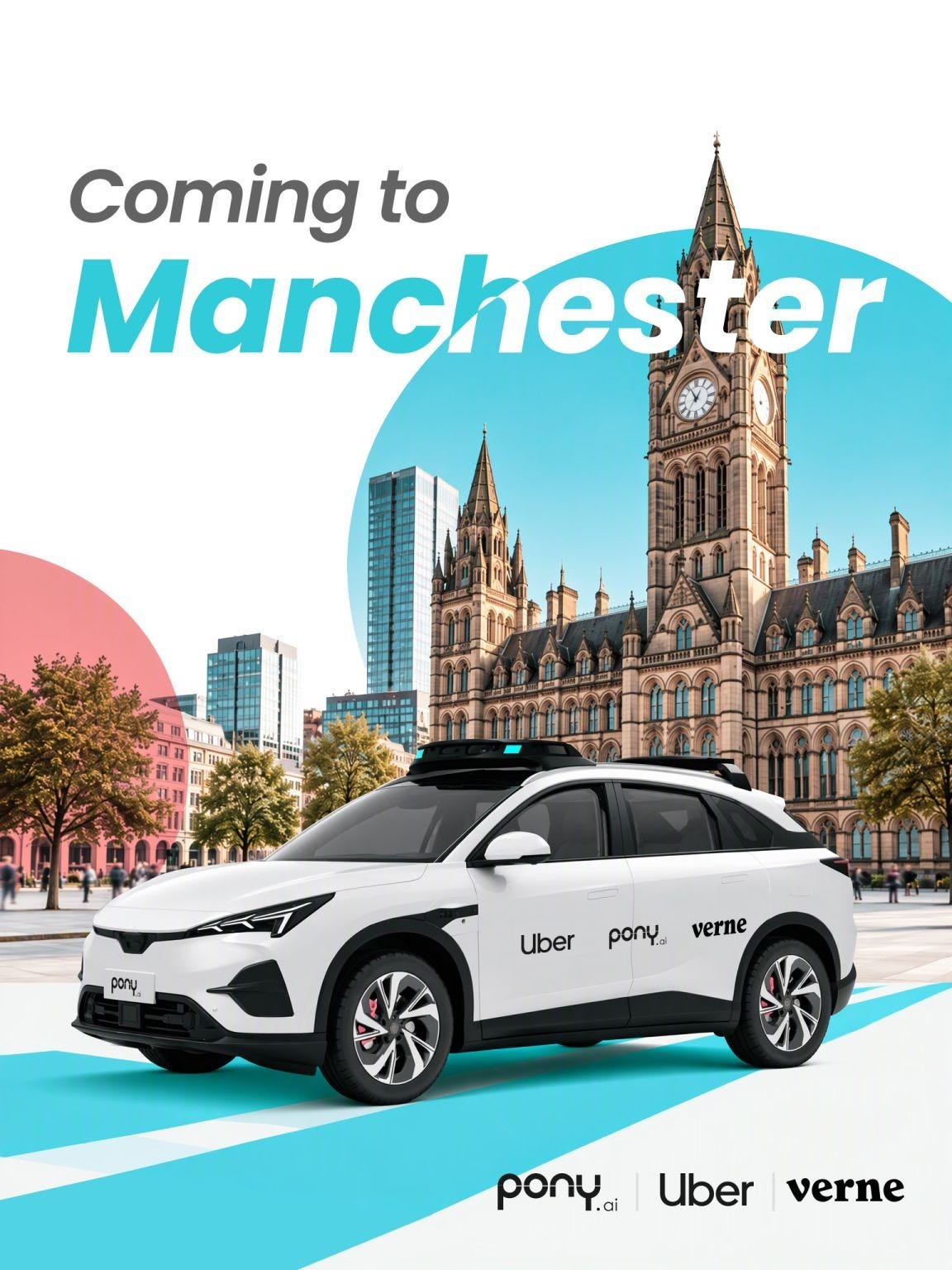
Pony.ai has started testing its 7th generation robotaxis in Manchester, its second UK city in a week after London. Uber and Verne are back on board, with setup being the same as in Zagreb: Pony’s driving technology, Verne fleet management, and booking through Uber. Testing starts with a safety driver and no passengers, but no application has been filed to run a passenger service yet.
Verne has also started testing fully driverless rides in Zagreb, with no safety operator on board. The tests began in August on the 22-kilometer (14-mile) route between Verne’s headquarters and the airport, and Verne hopes to open driverless rides to the public next year. Its fleet of about 30 vehicles serves around 1,500 riders, with more than 10,000 on the waitlist. Rides are still fixed at 1.99 euros, which would absolutely entice me to join the waitlist as well.
In London, an Assembly committee has called for TfL to get more power to regulate robotaxi services, and union members protested against the robotaxi trials in King’s Cross over the weekend.
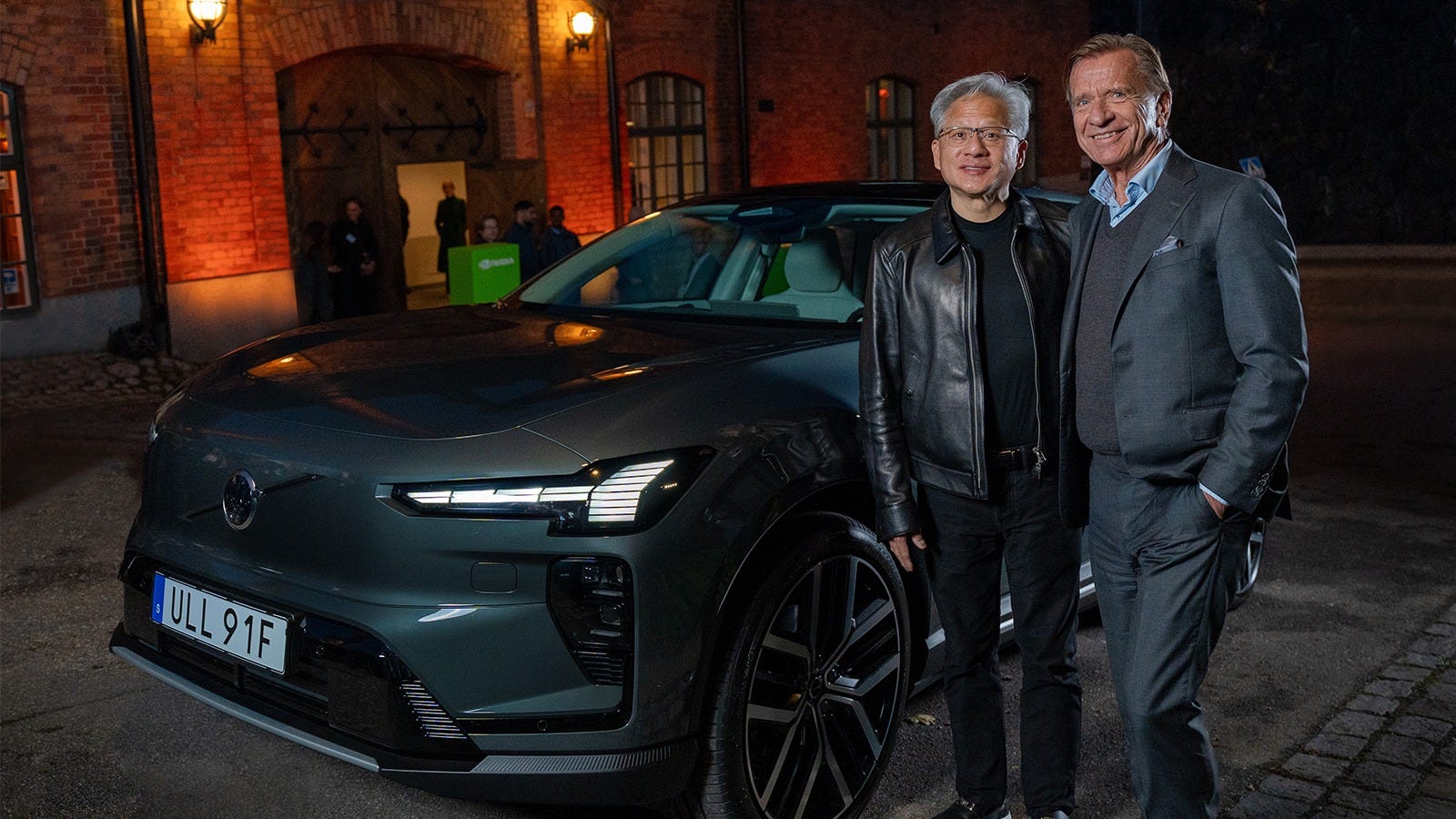
Volvo and Mercedes-Benz have both expanded their Nvidia partnerships, a day apart. Both will build on the same three Nvidia products, the Hyperion sensor and compute architecture, the Alpamayo driving software, and the Halos safety system.
Volvo’s system will debut in a next-generation car and handle door-to-door driving on highways, city streets, and in parking lots. Volvo says it’ll gradually introduce eyes-off and mind-off driving, though it hasn’t said which model comes first or when.
Mercedes will pair the Nvidia stack with its MB.OS operating system for point-to-point urban driving assistance and automated parking, and to develop future Level 4 applications, including robolimousines. Like I wrote three weeks ago, Mercedes also signed a deal with Wayve last month, so it’s now working with both.
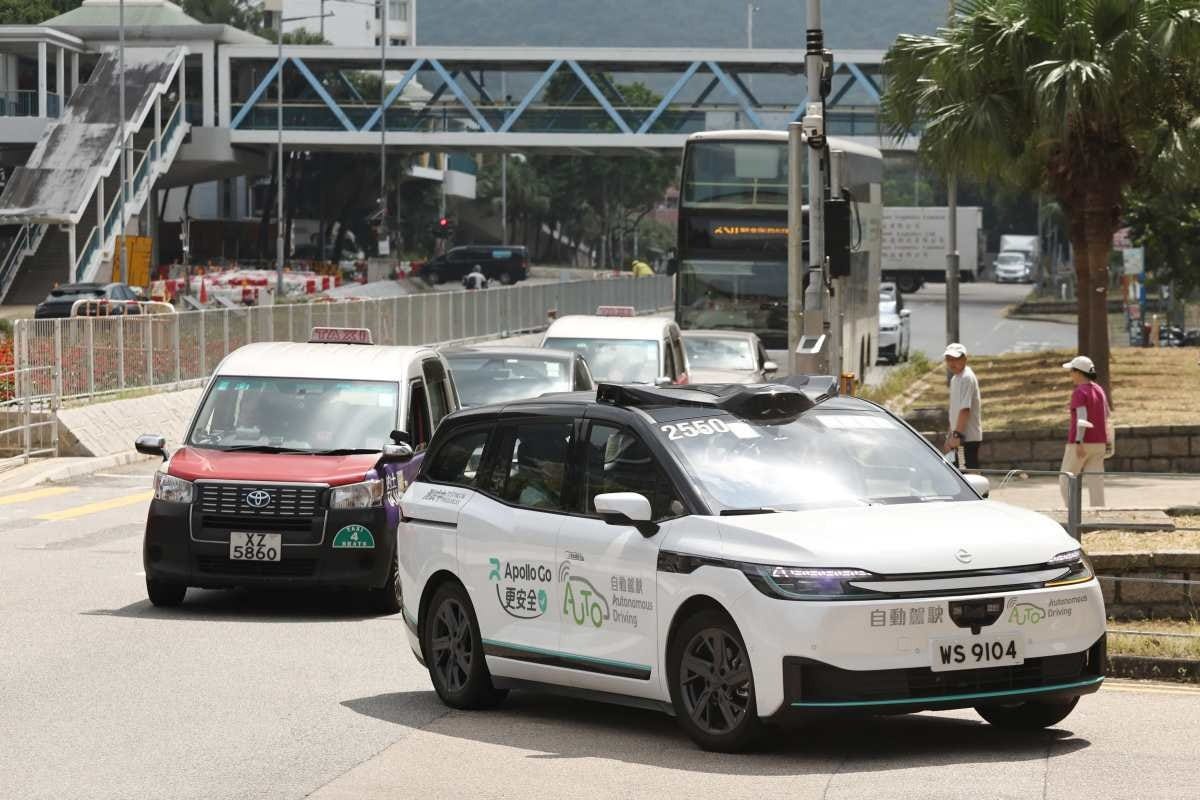
Baidu’s Apollo Go will give free robotaxi rides to the public in Hong Kong, its first public trial in the city, from October 21 to November 3 in Tung Chung. Each ride takes about 15 minutes on a fixed 5.1-kilometer loop, with up to two passengers and the front seat off-limits. More than 1,000 residents are expected to ride, using physical tickets handed out by district offices. Apollo Go was the first company to get an AV pilot license in Hong Kong and has driven more than 280,000 kilometers there.
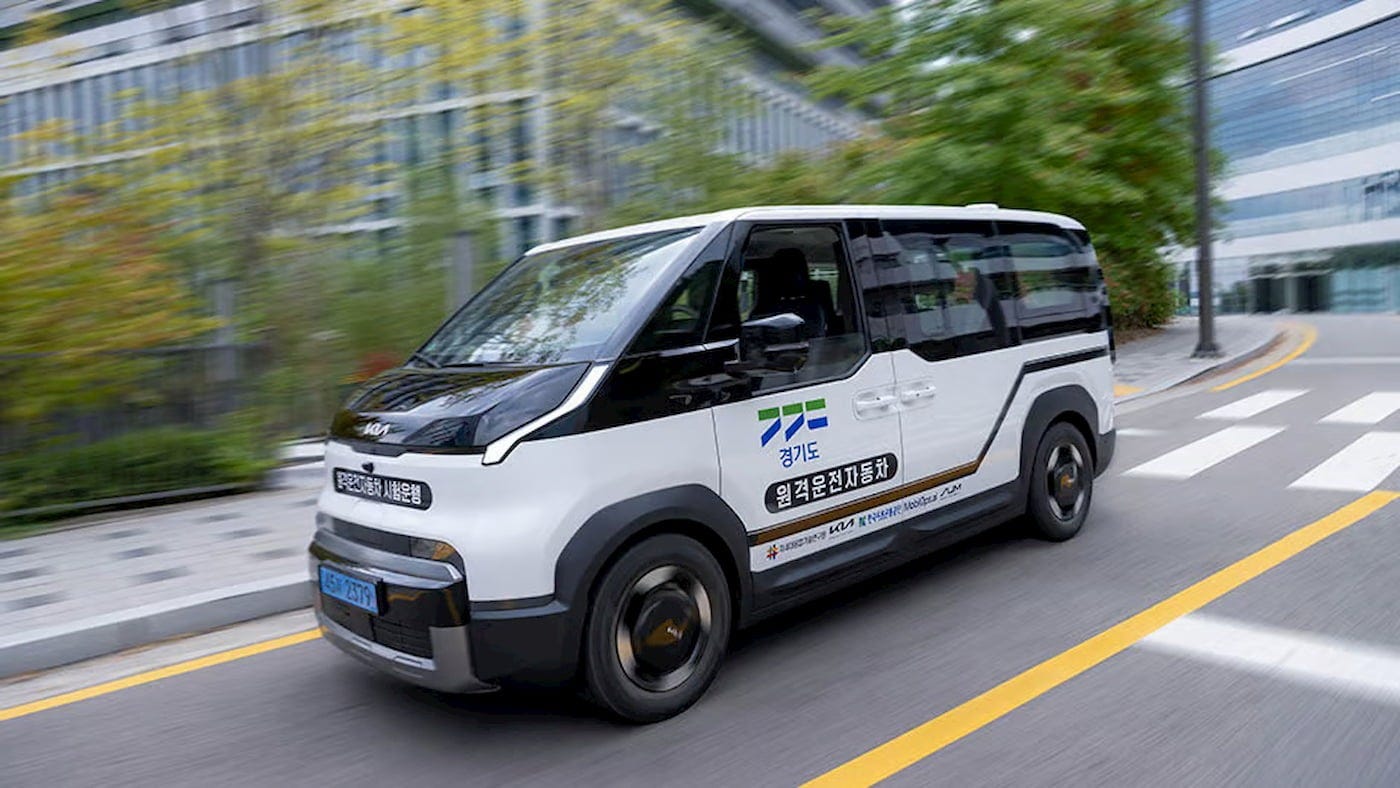
Kia has launched a remote-driven car-sharing pilot in South Korea, using its PV5 electric van in Pangyo. Customers book a van through an app, and a remote driver brings it to them over 4G or 5G with nobody inside. The customer drives it like a normal rental and leaves it wherever they’re done, and a remote driver takes it back to the garage. Startup SUM built the remote driving system. The pilot runs until the end of the year, and Kia plans to expand the service in 2027.
While Kia’s system is being hailed as a “first of its kind”, companies like Vay have been operating the same service in Las Vegas for a few years now. Vay’s service operates the same way as Kia’s is described to operate, with the same remote driving setup. Vay, however, uses the Hyundai Niro for its fleet of remote-driven rentals.
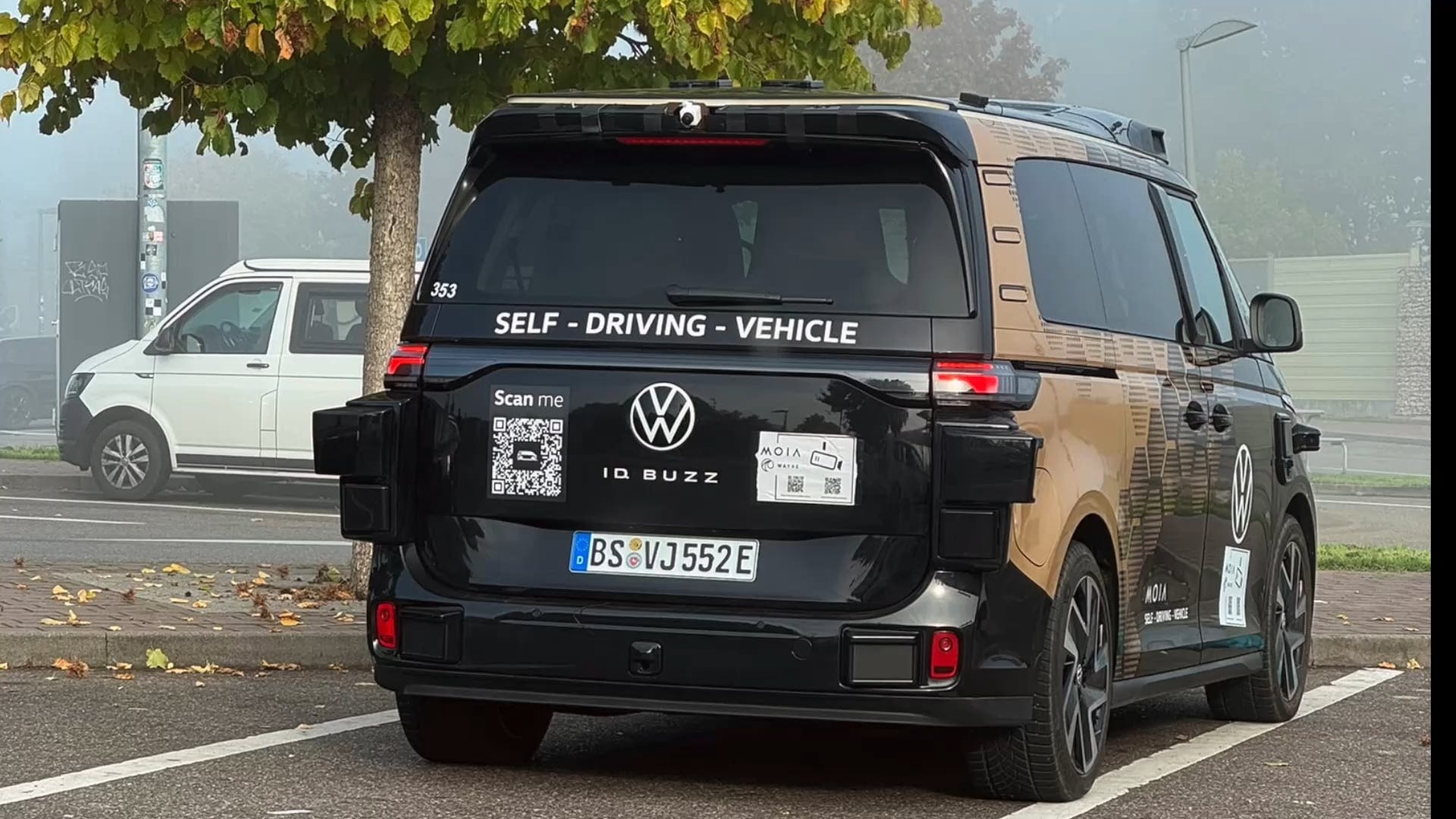
A MOIA ID. Buzz carrying a Wayve sticker has been spotted in Germany, parked at a rest stop on the A8 autobahn. MOIA is Volkswagen’s autonomous mobility unit, and its ID. Buzz AD currently runs Mobileye’s self-driving system. Like I wrote two weeks ago, VW has reportedly picked Wayve as its automated driving partner, but it hasn’t confirmed the deal. Neither VW nor Wayve has said anything about MOIA yet, so it’s unclear whether Wayve would work alongside Mobileye or replace it.
Robot Rights > Human Rights?
And in Philadelphia, a woman has been arrested for blocking an Uber delivery robot, and charged with disorderly conduct after ignoring multiple police orders to move. This was reportedly not the first time she had stood in front of robots to protest them taking jobs from human couriers. Is this the first known case of a human being arrested for obstructing a robot? Will companies start advocating for a robot bill of rights? Will we finally see detectives in autonomous Audis fighting red-glowing humanoids on public roads?
Alright, that’s it from me… until next week. If you enjoy this newsletter, share it with your friend, colleague, or boss. Thank you for reading, Sophia out!
Another fine weekly digest! This time, thanks for the editorial on all things autonomous seen during your recent visit to China.
I heard similar assessments from others who were out and about in public there: lots of air about how wonderful and cutting edge China is with the latest technology only to discover that people still needed to hold a robot’s milkshake-making hand when it came to real-life experiences.
Every new thing needs time to ramp up for Actual to agree with Expected. Looks like a few more years are needed, Sophia, before you’ll be able to take another normal ride in a hotel elevator though (would loved to have been a fly on that wall)...
In the ‘Robot Rights > Human Rights?’ story, I think the question, ‘Will finances drive decisions, again?’ could also be posed.