


Welcome back to Ground Truth, a new series from Ride AI that focuses on the entrepreneurs and executives building the infrastructure layer for scaling autonomous vehicles.
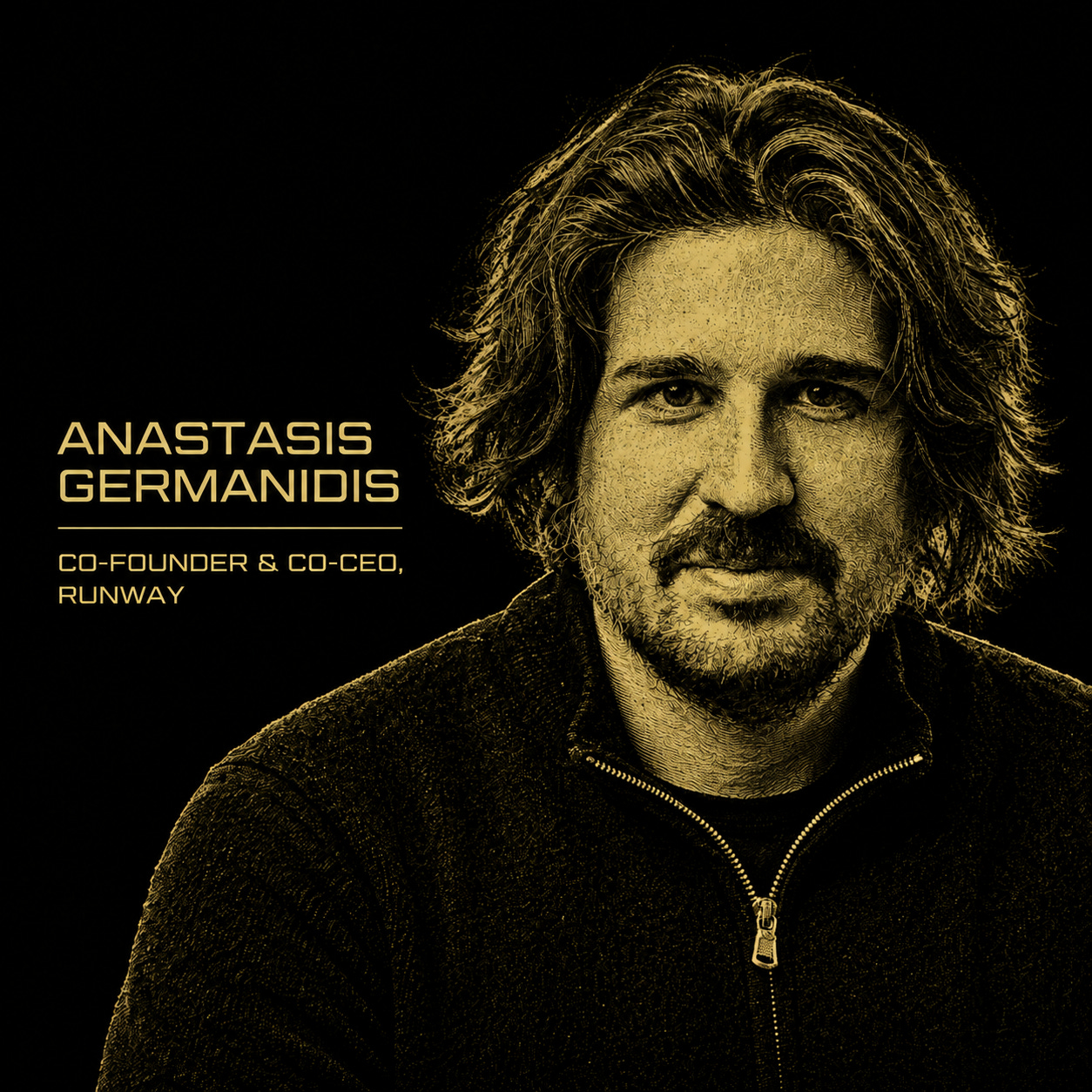
In this week’s sponsored edition, we’re talking to Anastasis Germanidis co-founder and co-CEO of Runway, ahead of their Runway AI Summit which is less than two weeks away and almost at capacity. If you’d like to attend, please purchase your tickets now with code RIDEAI30 for 30% off registration.
To suggest candidates for us to feature in Ground Truth or to get in touch about partnership opportunities for the series, drop me a note at mike@rideai.org.
On World Models and Building a “Wind Tunnel” for Autonomy
In February, Runway closed a $315 million Series E led by General Atlantic, with NVIDIA and AMD Ventures participating, roughly doubling the company’s valuation to $5.3 billion. Runway was direct about where the money was going: pre-training the next generation of world models (which the company has called the most transformative technology of our time) and bringing them into new products and industries.
Runway co-founder and co-CEO, Anastasis Germanidis, has been building toward that claim for years. In an essay published in July, he drew a line between two kinds of machine intelligence: the kind learned by hammering on closed environments where a perfect simulator already exists (i.e.- why models can win math olympiads) and the kind needed to act well in complex, partially observed systems…….which is why those same models still struggle to run a vending machine business. His proposed fix alludes to the Wright brothers’ wind tunnel. In 1901 they could only test a wing redesign by building a full-size glider and hauling it to Kitty Hawk; a box with controlled airflow let them screen two hundred designs in a single season. Scaling AI in the physical world, he argues, means building a wind tunnel for every domain where experimentation is slow and expensive.
There’s early evidence backing this approach. Runway published work this year applying world models to robot policy evaluation, where simulated and real-world outcomes correlated at 0.95 across eight policies. In scenarios where the comparison method required physically scanning a scene and rebuilding it by hand, the world model needed only a handful of starting images.
The more telling signal for the Ride AI audience may be Solaris, the interface world model Runway announced this month, which generates working software UI frame by frame and treats clicks and drags the way GWM-1 treats robot commands. Both run on the same base model. What changes between a robot arm, a game world and a piece of software is the action space, not the architecture, and Runway’s stated direction is to collapse those domains into a single general model.
Ride AI caught up with Anastasis ahead of the Runway AI Summit in San Francisco on September 30 — where he'll be joined by leaders from NVIDIA, Wayve and Physical Intelligence for a conversation on what video teaches a model that driving logs can’t, why one base model now generates software as readily as physical space, and whether a general world model can compete with one trained on 200 million autonomous miles.
At its core, Runway is known largely as the company much of Hollywood runs on. Fewer know you as a world-models company. Walk us through the evolution from Gen-1 to GWM-1 and how a company with roots in creative has evolved to build real world intelligence?
My co-founders and I have been focused on this idea of creating systems that understand the visual world for a long time. Even the earliest models had developed some understanding of physics and motion to generate realistic short videos. World models are an extension of the work that we’ve been doing over most of the last decade, scaling video generation models.
Today, GWM-1, our general world model, can generate frame by frame, run in real time, and be controlled interactively with actions, like camera pose, robot commands, and audio. Last week we announced the first Interface World Model: Solaris. It treats clicks and drags as the actions and renders the interface itself frame by frame, in real time.
Runway isn’t a creative tools company switching paths to build world models. Creative tools were just the start. Runway is building models that learn the world by predicting it, and that unlocks different use cases at different levels of capability.
Your position is that you had to build a great video model before you could build a world model. For most of our readers who haven’t spent time in generative media, get concrete: what does a model learn from large-scale video that a model trained on say, driving logs or teleop data doesn’t?
Our definition of a world model has been largely the same since we first introduced the idea in 2023: an AI system that builds an internal representation of an environment and uses it to simulate the outcomes of actions in that environment. The same idea can be applied to open-world navigation, robotic manipulation, digital user interfaces, and many other kinds of environments.
The case for large-scale video pretraining as the starting point is that video is the richest real-world supervision signal available at scale. A model trained this way has already learned how a pedestrian stumbles or how a cyclist swerves around an opening car door from millions of clips that never came from a car. A fleet can log hundreds of millions of miles and see a given failure mode a handful of times, which is where the prior from video pretraining helps.
Solaris points the same base world model at software interfaces instead of physical space. What does that generalization tell an autonomy audience about GWM-1?
Solaris follows the path we opened with GWM-1. It’s a real-time interactive model that generates user interfaces, with every frame generated as you interact. Solaris treats user input as conditioning for the next frame, the same way that we use robot commands in GWM-1. The only thing that changes is the action space.
Today, Worlds, Avatars, Robotics, and Solaris are separate post-trained models and applications of real-time interactive generation, and we’re working toward unifying many different domains and action spaces under a single base world model. We expect one general model to outperform domain-specific ones, with progress on one task carrying over to the others.
This audience has watched Waymo ship a world model trained on roughly 200 million autonomous miles, Wayve ship GAIA-3 specifically for evaluation and validation, and Nvidia build out Cosmos. All of them have proprietary driving data you don’t. What’s the argument for a general world model in a domain where the incumbents believe their moat is precisely the specificity of their data?
Proprietary driving data is a real advantage for the common cases. It’s less helpful for the rare ones, since a fleet tends to encounter each failure mode only a handful of times, however many miles it logs. A model pretrained on video has seen far more of those situations, most of them in footage that had nothing to do with driving, and some of that carries over into simulation. We see the two as complementary. Fleet data is what you’d fine-tune and validate against. The general model can help fill in the situations the fleet hasn’t run into yet.
We believe that world models are very early. Early fields can move much faster when the people building them talk to each other. That’s part of why we’re hosting the Runway AI Summit in San Francisco on Wednesday, September 30. Ming-Yu Liu, who runs NVIDIA’s Cosmos Lab, is speaking. So are Alexander Toshev from Wayve, Quan Vuong from Physical Intelligence and Richard Ahlfeld, who leads physical AI at CoreWeave. If you’re building in AV or robotics and want to see where world models are useful today or will be in the near future, we hope you can make it.
You can learn more about Runway’s To see Anastasis live on stage at the Runway AI Summit on September 30 in SF, get your tickets now with code RIDEAI30 for 30% off registration.